Jump to a question in this guide
- What does a flood affect besides the visible water?
- When should I stay out and arrange urgent help?
- What do we actually know about the water and its route?
- Why can the inside of a wall remain a separate question?
- How are water removal, cleaning and drying different jobs?
- What determines whether a material or belonging can stay?
- How should I read a drying record?
- Does a mould sample tell us it is safe to return?
- Who decides what happens to electricity, heat and appliances?
- What should a restoration proposal explain before work expands?
- What needs to be resolved before new finishes conceal the work?
- How is returning to a room different from finishing the claim?
- What changes when the source or affected area is shared?
- How can renewed wetness change the recovery question?
- Which Canadian dates and local limits should stay in the file?
- How would a fictional household carry the event through to handover?
- Safe access comes before evidence gathering.
- Stopping new water, cleanup, drying, utility assessment and rebuilding are different jobs.
- A dry-looking finish or favourable sample is not all-system clearance.
- Keep the actual locations, methods, findings and remaining limits together.
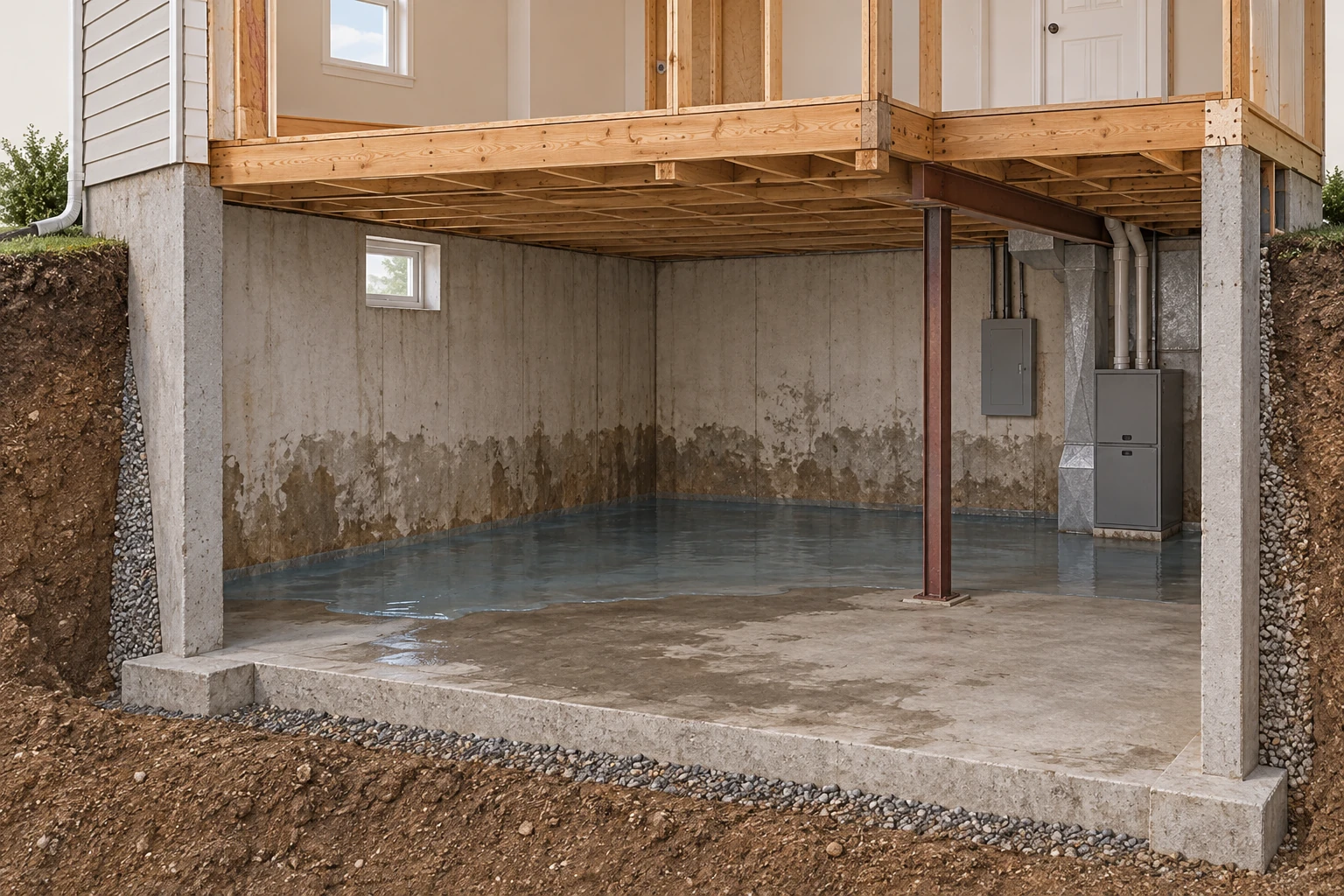
The water area, lower finishes and closed utilities share one basement. Water removal, affected assemblies and utility assessment therefore need connected but distinct scopes.
About this illustration
Dry exterior cutaway viewpoint is not an entry route. No water category, electrical isolation or safe access is established. This is a conceptual teaching model, not an assessment of your home.
9 picture lessons appear beside the questions in this guide. Use them to understand the explanation, then consider what it means for your home.
What does a flood affect besides the visible water?
A flooded room contains several different systems at once. The floor and wall finishes are the surfaces you normally see. Framing, insulation and the foundation sit behind or beneath them. Electrical equipment, heating equipment and plumbing can share that space. Furniture and stored possessions introduce still more materials. Water on the floor is therefore the beginning of several questions, rather than one cleanup task with one completion date.
The response has a connected sequence: establish safe access, understand the water event, assess affected areas, arrange suitable cleanup and material decisions, document drying, assess utilities and decide what can be restored or occupied. Some work overlaps, and urgent qualified assistance should not wait for a tidy folder. The sequence is a way to understand responsibilities, not a schedule for an owner to enter and perform the work.
A plumber may stop an escaping supply without assessing an insulated wall. A restoration provider may remove damaged finishes without authorizing electrical reconnection. An insurer may accept a document without judging concealed moisture. These people can cooperate, but their deliverables have different purposes. Ask each provider what they will establish and which related question requires someone else.
The whole-room cutaway places finishes, concealed layers and closed utilities together. It explains why a small-looking flooded area can need more than a mop. It supplies no water category, material-retention decision or safe access path. Use it to identify the parts of your record, keeping the actual property and event separate from this conceptual house.
This guide concerns recovery after an event. The existing leak guide helps describe an ongoing water pattern, the mould guide explains recurrent dampness, and the insurance guide covers policy evidence. Follow those links for their distinct questions. Here the useful outcome is a supported account of what happened, what was assessed, what work was completed and what remains unresolved.
One wet room contains several recovery questions
The water area, lower finishes and closed utilities share one basement. Water removal, affected assemblies and utility assessment therefore need connected but distinct scopes.
Numbers identify the parts explained below.
- Visible water and finish
The visible room condition starts the affected-area account; it does not map hidden moisture.
- Wall and floor assemblies
Connected layers need their own assessment and drying record.
- Closed utilities
Electrical and mechanical equipment require their appropriate qualified scopes.
What does this illustration leave out?
Dry exterior cutaway viewpoint is not an entry route. No water category, electrical isolation or safe access is established. This illustration explains an idea. It is not an installation guide.
Which source, material and utility questions does the actual recovery plan cover?
Explore this with HomeAI ↗Opens an editable question. Nothing is sent until you choose to send it.When should I stay out and arrange urgent help?
Stay away from flooded or wet areas involving electrical equipment. Electricity can travel through water and wet flooring. Do not cross the room to reach a panel, disconnect an appliance or collect a photograph. Contact the utility and qualified electrical help from a safe location; use emergency services for an immediate threat. Rubber boots, a dry-looking patch or the apparent loss of power do not establish safe access.
Ontario’s Electrical Safety Authority separates the utility’s supply role from the electrical contractor’s assessment and repair role. Its Ontario reconnection process is not a nationwide procedure. Elsewhere, ask the local utility and electrical authority who determines safe access and what restoration arrangements apply. An owner should not infer that an electrician’s future appointment authorizes entry now.
Suspected sewage, chemical contamination, unstable construction, a bulging wet ceiling or other apparent immediate hazards also change the task. Keep people and pets clear and obtain appropriate emergency, public-health or qualified building advice. Do not enter to identify the precise water source or complete an inventory. An unknown condition should remain unknown while safe response is arranged.
Tell the responder what you know from outside the affected area: the location, reported water extent, any utility involvement and whether people remain inside. Say explicitly when the level, source or equipment contact is unobserved. That truthful limit helps the responder plan. Guessing that the water is below every outlet could make an incomplete account sound like an inspection.
An access decision has a scope and time. Ask which area it covers, who made it and which conditions would require renewed advice. Clearance for one professional to do a defined task is not automatically permission for a household to move belongings or sleep there. Keep the instructions in their original words and ask for clarification when different providers appear to be describing different permissions.
What do we actually know about the water and its route?
Begin with the event rather than a label. Record when water was first reported, the first location seen safely, known weather or plumbing events and who stopped an identified source. Water described as coming from a pipe, a drain or outdoors can raise different contamination and source questions. A photograph of clear water does not establish its composition or every surface it contacted.
Ask the qualified responder to explain the supported source and any uncertainty. A stain below a pipe may reflect water that travelled from elsewhere. Water in a basement after rain may involve more than one route. Keep a reported observation separate from a finding supported by inspection. If the source remains unconfirmed, the follow-up task is to resolve that uncertainty, not to rename it a foundation failure.
Contamination assessment should consider the actual event and conditions, not simply the original source description. Health Canada directs households with suspected sewage contamination toward local public-health advice. This guide provides no numbered water-category classification, disinfection concentration or owner sampling plan. Those would require the actual conditions and a suitable professional scope.
Source control and damage assessment are separate milestones. A report that a supply was isolated answers whether new water from that route was stopped under the reported conditions. It does not answer how far the previous water spread. Conversely, an extensive restoration scope does not establish that a recurrent exterior entry route has been repaired.
Preserve the first account even when later findings improve it. Add a dated correction identifying what the professional established and how it changes the plan. This avoids rewriting an early uncertainty into a fact that supposedly everyone knew from the start. It also helps later providers understand why the initial work scope changed.
Why can the inside of a wall remain a separate question?
A finished basement wall may include a painted face, gypsum board, framing, insulation and a foundation behind it. A floor can include a finish, an underlay and a slab or framed base. Each layer has its own contact with water and route for drying. Seeing the room surface does not expose the entire assembly or show where water stopped.
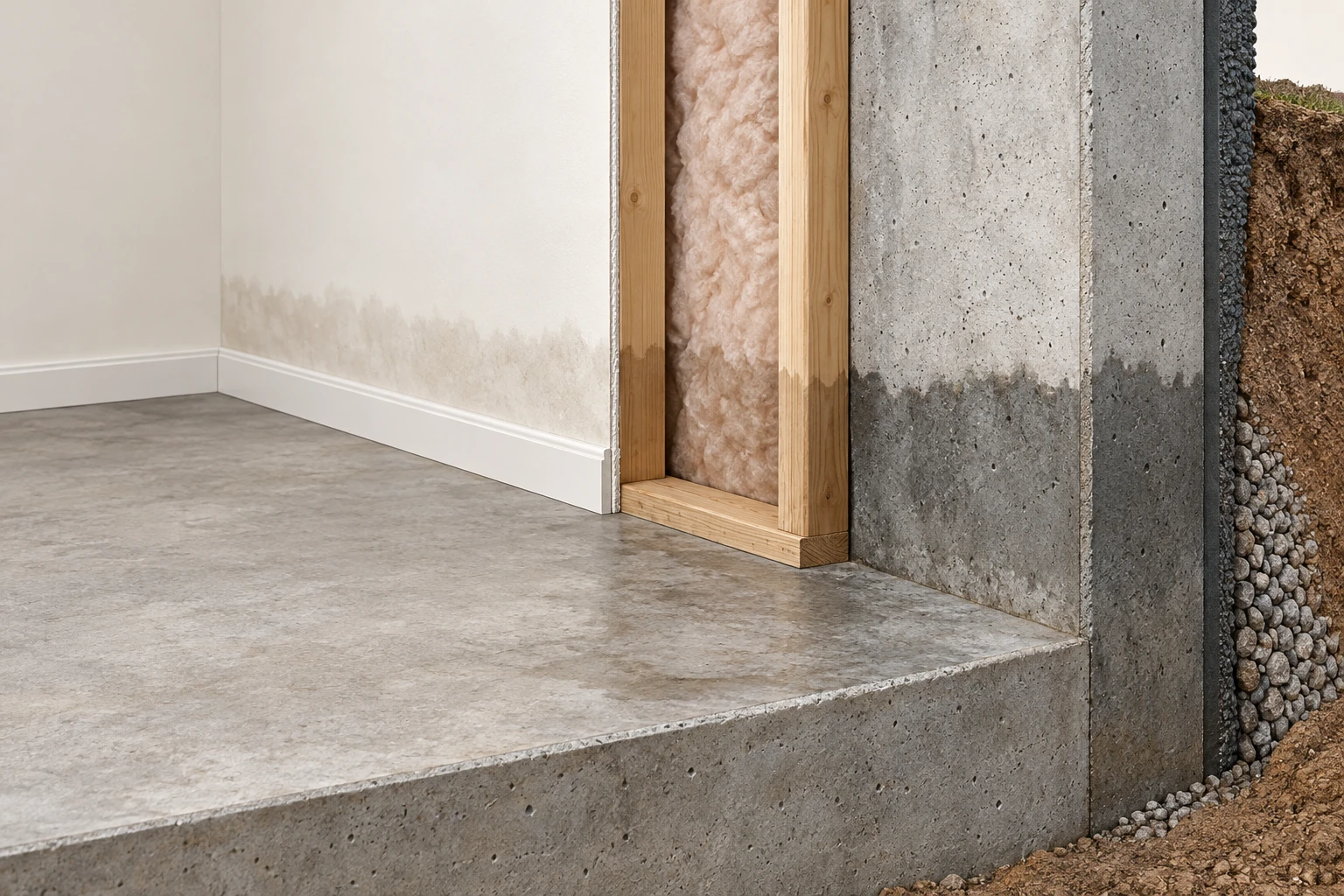
The layered cutaway teaches this distinction with deliberately different damp-looking bands. Those bands are conceptual, not measured migration in an actual house. The question for the provider is which materials and cavities were assessed, where access was limited and whether further investigation is needed. Ask for locations that can be matched to the room, rather than a general statement that the basement was checked.
An owner should not remove finishes, drill a moisture-test hole or pull insulation to improve the record. Disturbance can introduce electrical, structural and material hazards beyond the visible water. Have the appropriate professional determine access, safeguards and investigation. The written report should distinguish the areas actually exposed from areas inferred or left inaccessible.
Existing construction records can help explain the layers, especially where renovations changed them. Keep drawings, past photographs and known finish dates with their original provenance. A drawing is evidence of a proposed or recorded arrangement; it does not establish that every detail was built that way. Ask the assessor how the record relates to what they actually found.
This is also why a generic removal height or nationwide wall recipe would be misleading. Actual water extent, contamination, materials and assembly conditions matter. A diagram can explain the relationship without selecting a cut line. The restoration scope should state the supported reason for each retained or removed area and identify any related design work needed before rebuilding.
Water can affect connected layers behind the finish
Gypsum, timber, insulation and concrete form separate parts of the conceptual wall/floor junction. A visible face cannot establish the condition of every concealed layer.
Numbers identify the parts explained below.
- Gypsum face
The ordinary visible finish is only one part of the assembly.
- Timber and insulation
Concealed materials need an identified assessment scope.
- Concrete and junction
The base and interfaces remain connected to the wall question.
What does this illustration leave out?
Illustrative damp band and cutaway; no measured wet extent, approved assembly, cut line or removal instruction. This illustration explains an idea. It is not an installation guide.
Which layers were actually assessed and which remained inaccessible?
Explore this with HomeAI ↗Opens an editable question. Nothing is sent until you choose to send it.How are water removal, cleaning and drying different jobs?
Water removal deals with free water that can be collected or otherwise managed by the qualified response. Cleaning or remediation addresses affected surfaces, contamination and material decisions. Drying deals with moisture remaining in retained materials and assemblies. Restoration replaces or repairs the resulting construction. These jobs interact, but completing one does not silently complete the others.
Drying is a movement of water, not simply a machine running beside a wall. Once free water has been removed, some water can still be held in a retained material. As that water evaporates, it changes from liquid into water vapour, the gaseous form of water, and enters the surrounding air. Removing moisture from that air is a different part of the journey. The water has not left the building merely because it has left the visible material surface.
An air-moving fan circulates air. In a suitable professional drying arrangement, moving air helps exchange the moist air beside an exposed material with surrounding air. A circulating fan does not itself collect that water or establish that the surrounding air has become drier. It also does not clean contaminated material or establish safe access. Air movement and moisture removal therefore have different jobs, even when the qualified response uses them together.
A mechanically refrigerated dehumidifier removes moisture from air. Its fan moves air across a cold heat exchanger, where water vapour can condense into liquid. The collected liquid then has its own removal route, such as the container in the named Danby example. Refrigerant remains inside its sealed circuit; the collected water comes from the air. NRCan describes the refrigeration coils, compressor and fan as parts of this appliance, while the named manual identifies its evaporator coils and collected condensed water.
The air then passes through the rest of the appliance and returns to the room. The named Danby manual says warm discharged air is normal. That explains why a dehumidifier is not a room air conditioner delivering cool air, even though both use refrigeration. Warm air at an outlet, a running fan or water in a container is evidence about equipment activity. None alone establishes that every retained material has reached the condition needed for the actual recovery decision.
Hidden layers complicate the first part of this journey. Water inside a covered material or enclosed cavity needs a route out of that particular location; room air does not touch every concealed surface. A dry-looking painted face and changing room humidity can therefore coexist with unresolved moisture behind the finish. The qualified provider determines which materials can be retained, what access and drying arrangement are appropriate, and how findings support the conclusion. Contamination and electrical assessments come before any assumption that ordinary household equipment is suitable. These paragraphs supply no fan placement, wall-opening, drain, wiring, measurement or return-to-use procedure.
A room without standing water may still contain wet materials. A room that smells better may still have an unresolved source. A fresh finish may hide an area whose earlier condition was not recorded. Use these distinctions to ask what the current milestone means. The purpose is to understand the work, not to second-guess a provider from appearance alone.
Health Canada emphasizes prompt response to wet materials. Its flood leaflet’s 48-hour message is a reason for timely action, not a universal countdown to guaranteed mould, safety or clearance. Avoid treating a reported duration as a complete contamination assessment. The responder still needs the material, extent, event and access information appropriate to the actual home.
Ask the provider to describe which tasks can proceed together and which decisions depend on an earlier finding. For example, a retained wall assembly may need a documented drying assessment before finishes conceal it. Utility work may have its own separate release process. These dependencies should appear in the work plan so that one contractor’s schedule does not become an unsupported all-system completion claim.
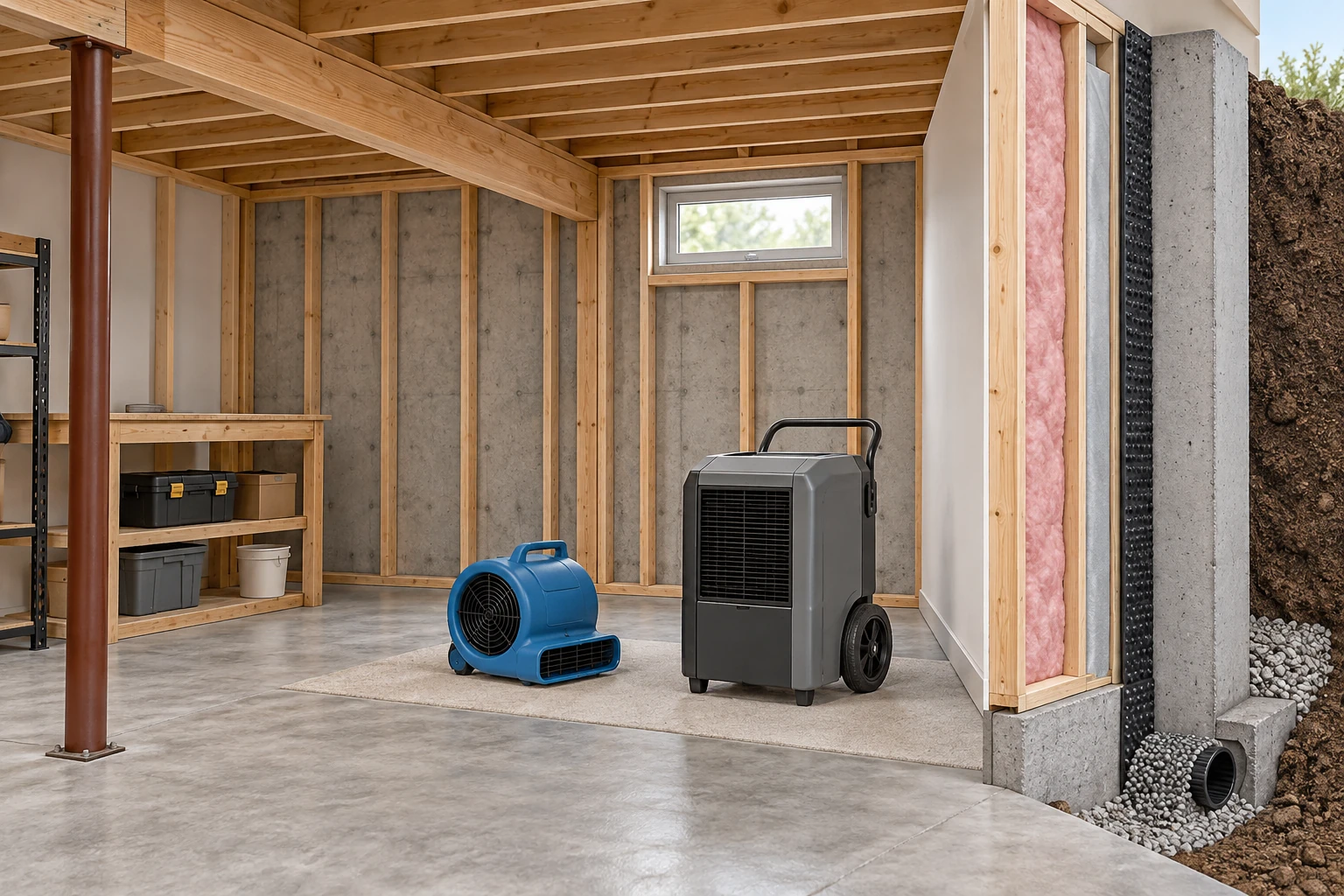
Do not arrange fans, temporary wiring, chemicals or improvised pumping from this article. Contaminated conditions and affected electrical equipment require suitable professional arrangements. The equipment picture intentionally leaves electrical connections and work procedures out. It teaches why the machines present in a room are evidence of a drying activity, while the documented condition of the actual materials answers whether its intended goal was reached.
Drying equipment and dry materials are different evidence
Closed drying equipment sits near the conceptual affected assembly. Its presence records an activity; the assessed condition of retained materials answers a different completion question.
Numbers identify the parts explained below.
- Closed dehumidifier
Equipment identity and use belong to the qualified drying scope.
- Air-moving unit
Its visible presence does not establish suitable airflow or work conditions.
- Affected assembly
Retained layers need location-specific assessed findings.
What does this illustration leave out?
Illustrative equipment and rug placement are not operating, contamination-control or electrical instructions; no performance or drying endpoint. This illustration explains an idea. It is not an installation guide.
Which material findings support the actual drying conclusion?
Explore this with HomeAI ↗Opens an editable question. Nothing is sent until you choose to send it.One flood, four connected recovery jobs
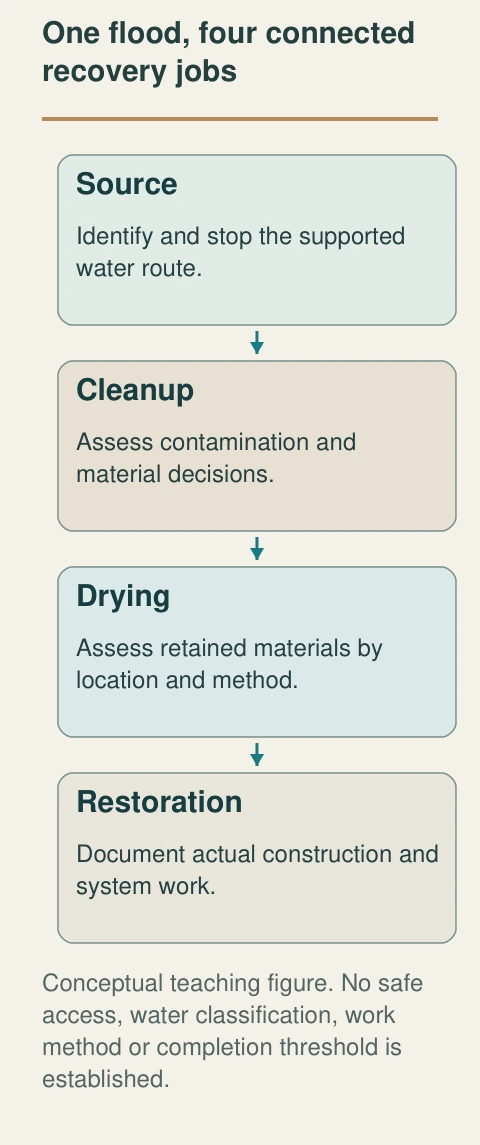
Stopping the source limits new water. Cleanup addresses affected materials; drying assesses retained assemblies; restoration repairs the resulting construction. Each job keeps its own completion evidence.
Numbers identify the parts explained below.
- Source
Identify and stop the supported water route.
- Cleanup
Assess contamination and material decisions.
- Drying
Assess retained materials by location and method.
- Restoration
Document actual construction and system work.
What does this illustration leave out?
No safe access, water classification, work method or completion threshold is established. This illustration explains an idea. It is not an installation guide.
Which job does each provider cover, and what actual evidence supports the next milestone?
Explore this with HomeAI ↗Opens an editable question. Nothing is sent until you choose to send it.Four jobs with different completion evidence
- Source controlWhat identified route was stopped or repaired, under which conditions?
- Cleanup and material decisionsWhich locations and items were treated, retained or removed, and why?
- DryingWhich retained materials were assessed, using which methods and limits?
- RestorationWhat construction and system work was completed and documented?
Organizing questions; no owner work method or universal completion threshold.
Further reading: Health Canada · Flood cleanup: keep in mind indoor air quality; Health Canada · Guide to addressing moisture and mould indoors.
Read the complete figure
One flood, four connected recovery jobs
Stopping the source limits new water. Cleanup addresses affected materials; drying assesses retained assemblies; restoration repairs the resulting construction. Each job keeps its own completion evidence.
- Source
- Identify and stop the supported water route.
- Cleanup
- Assess contamination and material decisions.
- Drying
- Assess retained materials by location and method.
- Restoration
- Document actual construction and system work.
What remains unknown: No safe access, water classification, work method or completion threshold is established.
A useful question: Which job does each provider cover, and what actual evidence supports the next milestone?
What determines whether a material or belonging can stay?
A tile surface, upholstered chair, cardboard box and structural timber do not present the same cleaning and drying question. The visible face is only part of an object; upholstery includes filling and backing, while a floor finish sits above other layers. The useful decision record identifies the item or material, its exposure and the professional reason for retention, cleaning, removal or further assessment.
Avoid deciding by price, appearance or sentimental value alone. Those considerations matter to the household, but do not establish whether the item can be safely restored. Explain particularly important items early, from a safe location, so the provider can identify any suitable specialist options. A request to consider an item is different from a promise that it can be recovered.
Health Canada’s guidance distinguishes materials that can be cleaned from porous materials that may need removal, with contamination and duration relevant to decisions. This article does not turn that guidance into an owner salvage list after an unidentified flood. Ask the responder which criteria apply and whether public-health or specialty conservation advice is needed.
An inventory can be assembled from existing photographs, receipts and safe professional documentation. Give each item a location and a dated status: reported affected, assessed, proposed for treatment or removed. Do not enter a restricted area to retrieve a serial number. A missing detail can remain a task for the people authorized and equipped to access it.
Keep disposal and insurance instructions connected without confusing their authority. The restoration provider addresses the material condition; local arrangements govern disposal; the insurer explains its documentation and claim process. Ask the relevant party before treating an instruction from another role as approval. No coverage, reimbursement or restoration result is implied by the educational example.
Different belongings need item-specific decisions
An upholstered chair, cardboard and a hard plastic container illustrate different material constructions. Their layers and exposure can ask different recovery questions.
Numbers identify the parts explained below.
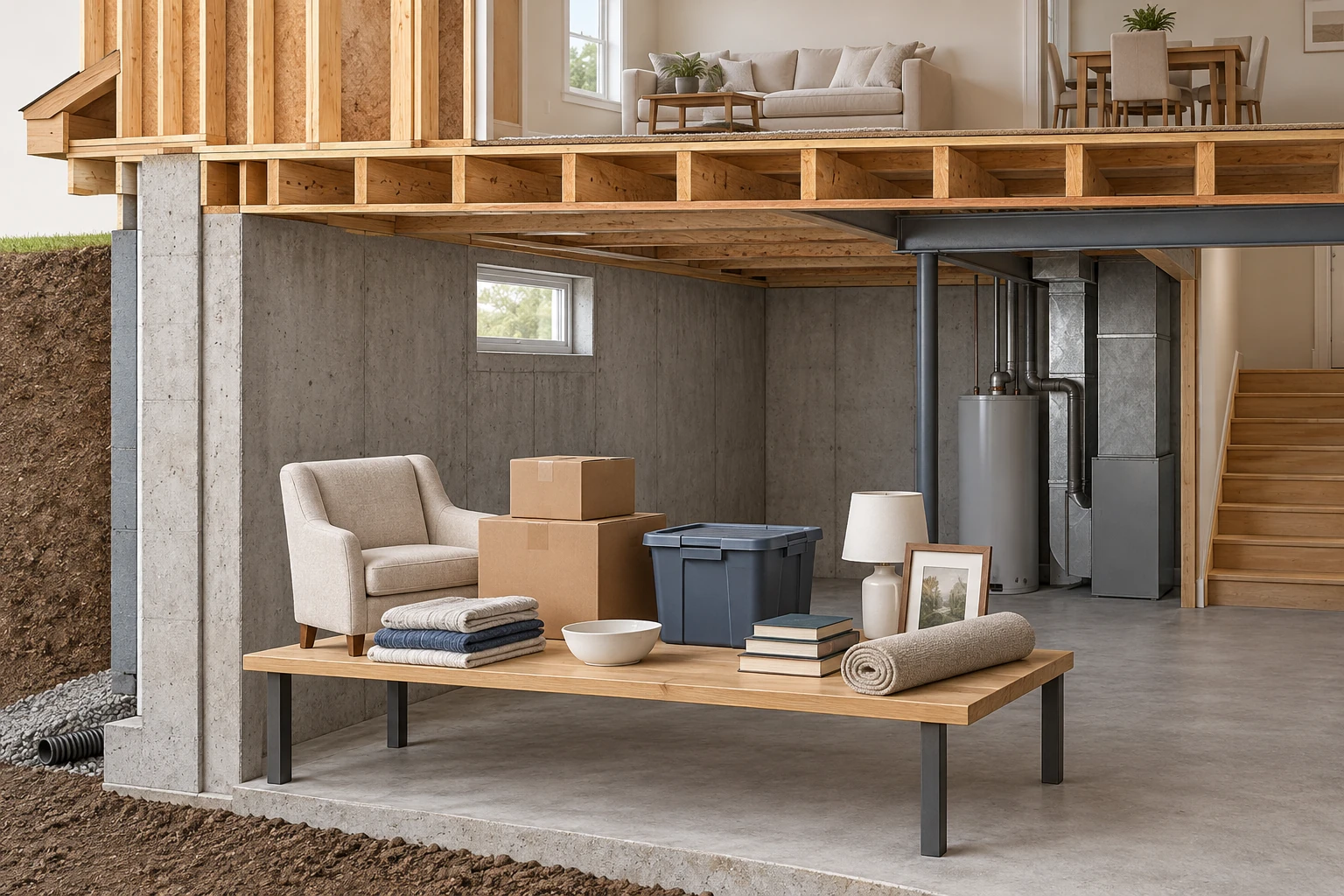
- Upholstered chair
Its face does not reveal all filling and backing.
- Cardboard
A different material requires its own exposure and retention question.
- Hard container
A different surface does not establish its contents or safety.
What does this illustration leave out?
Dry-looking comparison objects, not actual flood-conditioned items. No contamination, cleanability or salvage verdict. This illustration explains an idea. It is not an installation guide.
What supports the actual decision for each affected item?
Explore this with HomeAI ↗Opens an editable question. Nothing is sent until you choose to send it.How should I read a drying record?
A useful drying record connects a location, material, date, method and interpretation. It should explain which retained areas were evaluated and what the provider used to judge progress. A list of unexplained numbers is harder to use than a smaller set tied to the actual wall or floor question. Ask what each number means and which conclusion it supports.
Room-air conditions and material condition are different observations. An air reading describes the air at its identified location and time. A material assessment concerns the identified assembly under the method used. Do not copy a comfortable room reading into a statement that every concealed layer is dry. Let the qualified provider explain how their combined observations support the stated conclusion.
The same caution applies to a thermal image or an instrument photograph. Retain the provider’s interpretation, conditions and limitations with the image. Do not use a coloured patch as a self-contained diagnosis. This guide supplies no instrument setting, universal moisture percentage or numerical endpoint for closure; those depend on the actual method, material and scope.
Comparison over time is useful when the record explains what is comparable. Were the same locations and materials considered? Did the work expose an area previously inaccessible? Did another source event occur between visits? A changed result may need those details before it can be called progress, recurrence or a different condition. Ask the provider to describe the relevant changes.
Completion language should be specific. Retained material assessed under stated conditions is a bounded statement. Entire home permanently dry is a much broader promise that one visit cannot establish. Keep any excluded area and recommended follow-up visible, especially before new finishes make the earlier access impossible. The record should support the next decision without pretending to remove every future uncertainty.
Three questions about one affected material
Water contact, contamination and drying condition ask different questions. The actual assessment links location, method and findings without treating one result as complete recovery evidence.
Numbers identify the parts explained below.
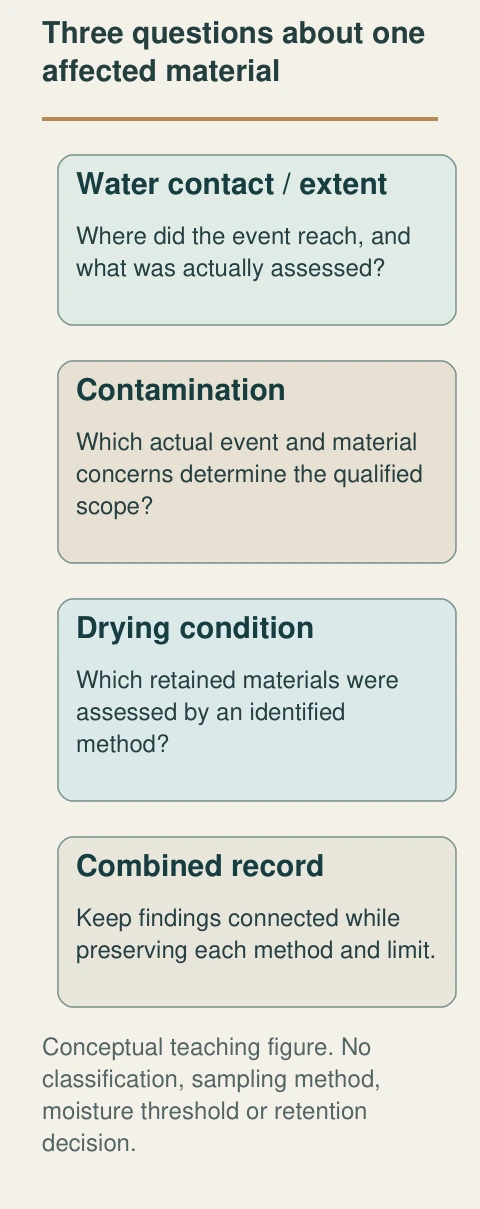
- Water contact / extent
Where did the event reach, and what was actually assessed?
- Contamination
Which actual event and material concerns determine the qualified scope?
- Drying condition
Which retained materials were assessed by an identified method?
- Combined record
Keep findings connected while preserving each method and limit.
What does this illustration leave out?
No classification, sampling method, moisture threshold or retention decision. This illustration explains an idea. It is not an installation guide.
Which evidence supports each actual conclusion and which remains unknown?
Explore this with HomeAI ↗Opens an editable question. Nothing is sent until you choose to send it.Read the complete figure
Three questions about one affected material
Water contact, contamination and drying condition ask different questions. The actual assessment links location, method and findings without treating one result as complete recovery evidence.
- Water contact / extent
- Where did the event reach, and what was actually assessed?
- Contamination
- Which actual event and material concerns determine the qualified scope?
- Drying condition
- Which retained materials were assessed by an identified method?
- Combined record
- Keep findings connected while preserving each method and limit.
What remains unknown: No classification, sampling method, moisture threshold or retention decision.
A useful question: Which evidence supports each actual conclusion and which remains unknown?
Does a mould sample tell us it is safe to return?
A laboratory result answers the question its sample and method were designed to address. It is not automatically an assessment of every room, concealed cavity or occupant. Health Canada generally does not recommend mould air testing and says it cannot predict health effects or usually identify the cause of damage. There is no health-based indoor mould exposure limit in that guidance.
A qualified professional may recommend a specific test where a defined concern remains unexplained. Ask what decision the test will inform, why the proposed locations and method are appropriate and how results will be interpreted. Request the report and its limitations, not merely a verbal pass. The presence of a laboratory logo does not expand the sample’s scope.
A visual and moisture investigation, source assessment, completed remediation and appropriate follow-up answer connected but different questions. If one of those is missing, a favourable sample should not silently fill the gap. Ask the provider to relate the test to the rest of the investigation. An unassessed cavity should remain named as unassessed even when another location has a result.
Colour and smell also have limited meanings. Do not identify a species, toxicity or medical risk from a photograph. A persistent musty odour or recurrent dampness is useful information for a qualified investigation, without being a diagnosis. Health concerns belong with a healthcare professional, who can consider the person’s circumstances alongside environmental information.
For extensive work, discuss whether a separate professional should review the completed remediation and remaining moisture questions. Independence is a scope decision, not a decorative certificate. Ask who performs the review, what they examine and which criteria and exclusions the report will state. This guide does not supply a universal clearance protocol or guarantee that one report resolves every return-to-use question.
Who decides what happens to electricity, heat and appliances?
Closed equipment has internal parts and connections that a room photograph cannot assess. A furnace that looks dry on the outside, an outlet above the reported water line and an appliance that still lights up each raise their own questions. Do not energize, reset or operate affected equipment to see whether it works. Arrange the appropriate qualified assessment.
The electrical contractor’s scope should identify affected electrical components and any required repair or replacement. The utility manages its own supply and restoration responsibilities. Ontario ESA describes a notification and acceptance process for Ontario work; retain the actual local documents for your location. A general restoration invoice is not an electrical acceptance record.
Heating, fuel-burning and other mechanical equipment may need their own provider and manufacturer-specific assessment. Ask whether the appointment covers the appliance, its controls and relevant connections, and what remains excluded. Do not assume that the electrical assessment also certifies combustion, venting, refrigeration or the condition of an appliance’s internal materials.
For each system, keep identity, event involvement, findings, work and authorization separate. The record might say that the utility disconnected supply, a named contractor assessed an identified area and later work was completed. Each event retains its date and scope. Avoid compressing those entries into power was back, therefore the basement was cleared.
If equipment is replaced, preserve the old finding and the new installation record together. New equipment can resolve an identified equipment task without proving that surrounding assemblies are dry or the water source is permanently controlled. A useful handover explains normal use, future fault response and maintenance for the actual replacement, including whom to contact when another water event occurs.
Closed utility equipment keeps separate specialist scopes
The closed furnace, electrical enclosure and appliance illustrate systems that can share a flooded room without sharing one assessment or restoration authority.
Numbers identify the parts explained below.
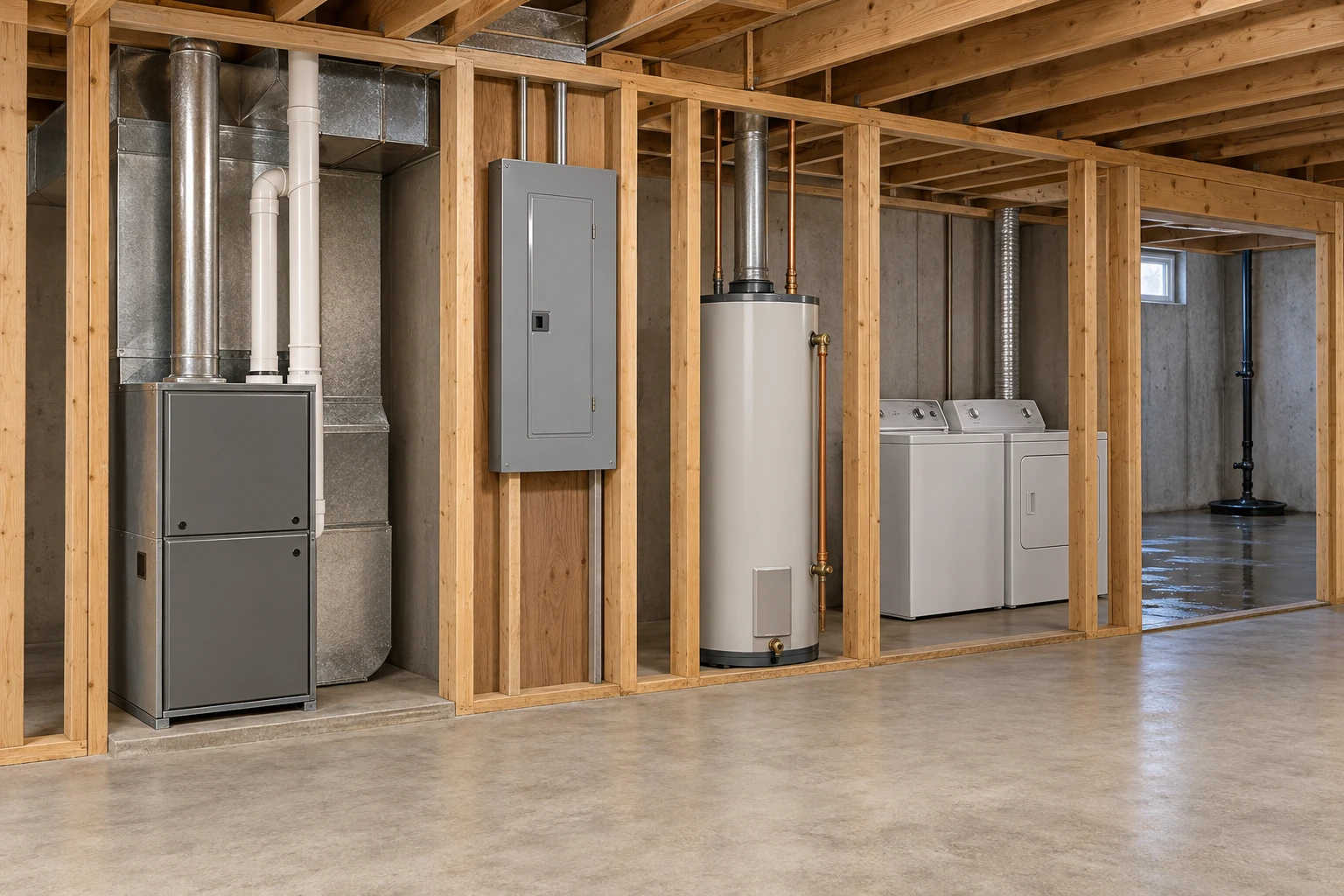
- Electrical enclosure
Its intact-looking exterior is not an electrical assessment.
- Heating equipment
Mechanical and related connections have their own qualified scope.
- Appliance
Actual model and flood involvement need a separate service decision.
What does this illustration leave out?
No internal condition, safe supply, repairability or reconnection approval; no owner operation shown. This illustration explains an idea. It is not an installation guide.
Who covers each system and what actual completion documents are needed locally?
Explore this with HomeAI ↗Opens an editable question. Nothing is sent until you choose to send it.Different providers answer different questions
Electrical, mechanical and material findings can support one recovery while retaining separate scopes. A document from one role should not silently certify another system.
Numbers identify the parts explained below.
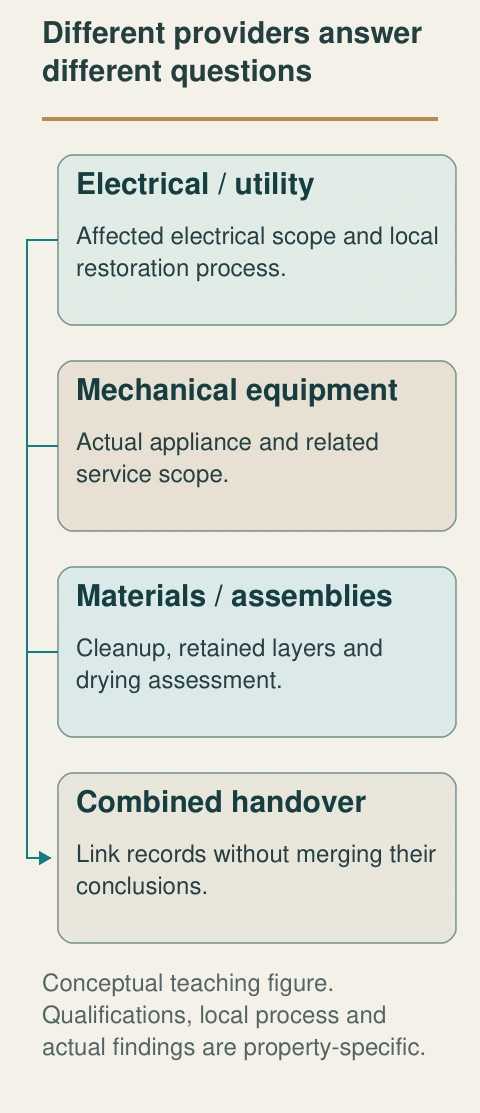
- Electrical / utility
Affected electrical scope and local restoration process.
- Mechanical equipment
Actual appliance and related service scope.
- Materials / assemblies
Cleanup, retained layers and drying assessment.
- Combined handover
Link records without merging their conclusions.
What does this illustration leave out?
Qualifications, local process and actual findings are property-specific. This illustration explains an idea. It is not an installation guide.
Who owns each unresolved utility, equipment and assembly task?
Explore this with HomeAI ↗Opens an editable question. Nothing is sent until you choose to send it.Separate utility and building findings
- Electrical and utilityAffected electrical scope, repairs and local supply-restoration process.
- Mechanical equipmentActual appliance, controls and connections within the named service scope.
- Materials and assembliesAffected layers, cleanup, drying and concealed-area limits.
- Return to useThe identified space and intended use under actual professional and local advice.
Ontario electrical documentation is not a nationwide template.
Further reading: Electrical Safety Authority · Flood Safety; Health Canada · Guide to addressing moisture and mould indoors.
Read the complete figure
Different providers answer different questions
Electrical, mechanical and material findings can support one recovery while retaining separate scopes. A document from one role should not silently certify another system.
- Electrical / utility
- Affected electrical scope and local restoration process.
- Mechanical equipment
- Actual appliance and related service scope.
- Materials / assemblies
- Cleanup, retained layers and drying assessment.
- Combined handover
- Link records without merging their conclusions.
What remains unknown: Qualifications, local process and actual findings are property-specific.
A useful question: Who owns each unresolved utility, equipment and assembly task?
What should a restoration proposal explain before work expands?
A clear proposal names the affected locations, the investigation or work to be done, the deliverables and what is excluded. It should explain how new findings change the scope and how the household is informed. This matters when concealed damage is discovered: the new task should be connected to the finding that prompted it, rather than appearing as an unexplained extra.
Ask who is responsible for source investigation, material decisions, drying assessment, utilities, rebuilding and any independent review. One company may coordinate several roles, but the written plan should say how. Confirm appropriate experience and qualifications for the assigned work without inventing a single national flood-restoration licence that covers every specialty.
The proposal should also explain household access and communication. Which areas remain restricted? Who tells occupants that conditions have changed? How are belongings, waste and nearby unaffected areas addressed? These are questions for the provider’s site-specific plan. HomeAI supplies no containment design, protective-equipment specification or work method for contaminated areas.
Keep estimated work, authorized work and completed work visibly different. An estimate describes a proposed task; an invoice describes a charge; a completion report should explain what was actually done and assessed. Request the relevant documentation before a milestone is treated as finished. None of those documents alone necessarily represents the local authority’s required approval.
When comparing proposals, compare their responsibilities and deliverables as well as price. A cheaper quote may cover a smaller scope, while an expensive package may still exclude the source. Ask each provider to explain the difference in familiar terms. This guide provides no repair price, insurance valuation or preferred vendor recommendation.
What needs to be resolved before new finishes conceal the work?
Rebuilding changes access. Once a wall is closed or a floor is covered, the earlier layers and interfaces are harder to see. Before that milestone, ask which retained materials were assessed, what source work was completed and which unresolved findings affect the new assembly. A finish schedule should follow those answers rather than replace them.
Have the responsible people retain dated location-specific photographs of the work they can safely access. An image is useful when its caption says what it shows, when it was taken and which stage it records. A close view of one repaired corner does not document every transition. Keep the wider room location and the provider’s explanation with it.
A replacement assembly also needs a suitable design for the actual foundation, climate and intended use. The existing basement-retrofit guide explains water, air, heat and drying functions. This flood guide does not prescribe insulation, vapour layers or replacement materials for all Canadian basements. Ask who is responsible for design and any required authority review.
Previous construction uncertainty should remain visible. If an earlier renovation lacks drawings or a cavity remains inaccessible, record the limit and how the team chose to address it. Do not turn the absence of a reported problem into a documented inspection. A clear unresolved item is more useful to future work than a reassuring sentence with no supporting scope.
Retain the actual closing decision: who made it, what conditions and evidence supported it and what follow-up remains. This is not a portal-issued approval to cover materials. It is a way to preserve the professionals’ and authorities’ own records so a later household can understand the work without reconstructing the entire event from paint colour and receipts.
How is returning to a room different from finishing the claim?
Return to use concerns the people, space and systems involved. A household may need answers about access, remaining work, utilities, cleaning and any local public-health or building directions. Claim administration concerns policy and documentation. The dates may coincide, but closing one process should not silently close the other.
Ask the responsible providers to state which area and intended use their conclusions cover. Temporary access to retrieve an item differs from routine occupancy. A finished bedroom differs from an unfinished storage area. If a room’s intended use changes during rebuilding, that new use may raise additional building and system questions beyond recovery of the previous finish.
For individual health concerns, obtain healthcare advice and share relevant environmental information accurately. A restoration report should not diagnose symptoms or promise that every occupant will respond the same way. Equally, a symptom report does not identify the failed building component. The medical and building roles can inform one another while retaining their own evidence.
The final handover should explain completed work, remaining restrictions or tasks, equipment instructions and who receives a recurrence report. Ask what observations should prompt renewed contact. Keep the original event record and the completion documents together so the next concern can be compared with an identified baseline rather than an undocumented memory of a dry room.
A quiet period after restoration is worth recording with its actual duration and conditions. It is not proof against all future rain, leaks or system faults. Continue the agreed care and follow-up, without deliberately recreating the flood. The useful conclusion is specific work with supported findings and a usable response plan, rather than a guarantee that the home can never be affected again.
A finished room and a return decision differ
Return information should identify the space and intended use, connect completed findings and retain restrictions or unresolved tasks. Painting, an invoice or a claim closeout has a narrower purpose.
Numbers identify the parts explained below.
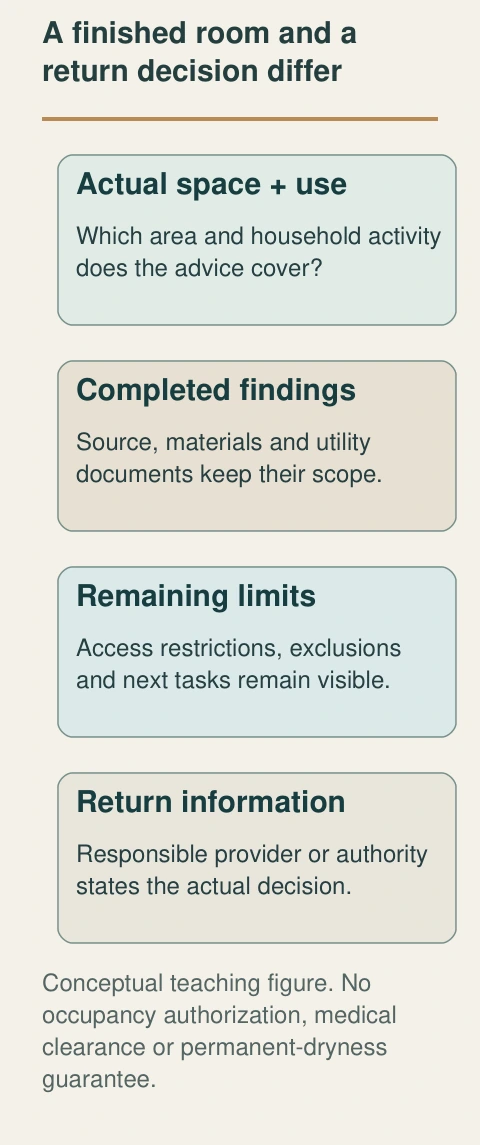
- Actual space + use
Which area and household activity does the advice cover?
- Completed findings
Source, materials and utility documents keep their scope.
- Remaining limits
Access restrictions, exclusions and next tasks remain visible.
- Return information
Responsible provider or authority states the actual decision.
What does this illustration leave out?
No occupancy authorization, medical clearance or permanent-dryness guarantee. This illustration explains an idea. It is not an installation guide.
What actual advice covers this space and intended use, and what still requires action?
Explore this with HomeAI ↗Opens an editable question. Nothing is sent until you choose to send it.What one document cannot replace
- Plumbing invoiceDoes not establish complete drying or electrical safety.
- New paintDoes not establish source resolution or concealed condition.
- Laboratory sampleDoes not predict every occupant’s health or cover every cavity.
- Claim closeoutDoes not substitute for the actual return-to-use advice.
Each document remains useful for its own stated purpose.
Further reading: Health Canada · Guide to addressing moisture and mould indoors; Electrical Safety Authority · Flood Safety.
Read the complete figure
A finished room and a return decision differ
Return information should identify the space and intended use, connect completed findings and retain restrictions or unresolved tasks. Painting, an invoice or a claim closeout has a narrower purpose.
- Actual space + use
- Which area and household activity does the advice cover?
- Completed findings
- Source, materials and utility documents keep their scope.
- Remaining limits
- Access restrictions, exclusions and next tasks remain visible.
- Return information
- Responsible provider or authority states the actual decision.
What remains unknown: No occupancy authorization, medical clearance or permanent-dryness guarantee.
A useful question: What actual advice covers this space and intended use, and what still requires action?
What changes when the source or affected area is shared?
In a multi-unit building, the first wet room and the source can belong to different spaces or responsibilities. A ceiling stain in one unit may follow water from above; a common utility area may affect several households. The safe response still comes first. Tell the relevant management or owner what is known from a safe location and ask who is coordinating access and the investigation.
The coordination file should name the actual unit or common area for each observation. Room names such as bathroom or basement can become ambiguous when several households report events. Preserve the reporter, date, floor and location without assuming a neighbour’s account describes your own materials. A shared event can produce different affected assemblies and different access limits.
Separate the source assignment from recovery in each affected area. A plumber working in one unit may identify a source without assessing another unit’s wall cavity. A common-area electrical task may have a different boundary from an appliance inside a dwelling. Ask the coordinator which providers will connect those findings and how the affected households receive relevant instructions.
The same distinction matters when one household receives a completion message before another. That message may cover a defined unit or task. It should not be forwarded as clearance of the whole building without the supporting scope. Keep each provider’s actual area and intended-use statement attached to the message rather than summarizing all rooms as ready.
Arrange documentation through the authorized people instead of entering another unit or restricted common space. Existing drawings and professionally supplied photographs can help identify shared routes, while preserving their limits. An owner’s missing view is a coordination question, not a reason to open a shaft, ceiling or service cupboard.
Discuss belongings, work access and temporary arrangements with the relevant parties using accurate technical findings. This guide does not allocate legal responsibility or decide which insurance contract pays. Those questions need the appropriate transaction, ownership or insurance advice. Technical source evidence can inform the conversation without being presented as a ruling on liability.
If accounts conflict, retain them separately and ask the responsible investigator what evidence could resolve the difference. A report of water above and a dry inspection later can both be true at their respective times. The aim is to connect the chronology and actual routes, not choose the most confident storyteller.
A useful shared-building handover names who receives recurrence reports and which areas remain outside the completed work. Keep this responsibility current when management or occupancy changes. The recovery is easier to explain when every household can see the relevant scope, while other residents’ private records are shared only through appropriate arrangements.
How can renewed wetness change the recovery question?
After initial work, a new damp appearance can raise more than one question. The earlier material may not have reached its intended assessed condition, another water event may have occurred, or a different moisture process may be involved. The visible location alone does not distinguish those possibilities. Keep the original finding and the new observation as separate dated events.
Start the follow-up account with what actually changed: location, appearance, timing and known weather or household use. Note whether work was still underway and whether the area was covered after the earlier assessment. Do not remove the new finish, deliberately wet the exterior or run fixtures to provoke a repeat. The professional can decide which comparison is safe and informative.
Compare the new question with the earlier scope. If the initial report assessed one accessible wall face, a later concealed-cavity concern may lie outside that record rather than contradicting it. If the initial source remained uncertain, renewed water may make the unresolved task more urgent without proving a particular route. Read exclusions as part of the evidence, not as small print to discard.
A source-repair record can also be narrower than the new event. Work at one gutter connection does not establish control of groundwater, plumbing or every opening. Ask the provider whether the new observation matches the repaired route and which other possibilities warrant assessment. The answer should link actual findings, rather than assume that recurrence means the same repair automatically failed.
The earlier drying record should retain its locations, methods and conditions so the provider can judge comparability. A new number at another material or measuring point is not automatically a trend. Likewise, a dry-looking visit after the new report may have a different weather and occupancy context. A useful report explains those differences rather than selecting whichever observation sounds reassuring.
Health Canada’s moisture guidance emphasizes resolving the source when problems recur and involving qualified help for hidden or unresolved conditions. That is a reason to return to the actual investigation. It is not an instruction to keep painting, add chemicals or purchase an air test in place of a source and material assessment.
Ask the responsible provider to state the next decision: further access, a source investigation, review of retained materials or another defined scope. Each proposal should identify the supported reason and the result it aims to establish. A list of all possible tests is less useful than a targeted plan answering the actual renewed concern.
When follow-up changes the conclusion, add the new finding without deleting the old record. The later report may explain why the earlier evidence was incomplete or why conditions changed. That history helps a future household understand the event honestly. It also prevents a recent clean finish from erasing an unresolved technical question that remains relevant.
Which Canadian dates and local limits should stay in the file?
The Health Canada flood leaflet was published in 2014 and its page details show November 2024. The moisture-and-mould body says January 2023 while its page details show April2020. These different fields are retained rather than silently converted into a new technical edition. A current reachable page is useful source evidence, but it does not make every referenced publication newly revised.
Ontario ESA’s flood page explains Ontario electrical roles and documentation. Other provinces and territories have their own utilities, authorities and qualification arrangements. Obtain current local instructions for the actual event. No Ontario certificate, title or restoration process is presented here as a requirement for every Canadian household.
Municipal drainage arrangements, waste handling, building requirements and shared-building responsibilities can also differ. In a condominium or rental, involve the relevant management or owner early while immediate safety is addressed. Ask who coordinates shared sources and areas. This guide does not decide ownership, coverage, landlord duties or the legal allocation of a repair.
Manufacturer and installed-model limits matter for equipment as well. A general flood article cannot determine whether an identified appliance is repairable or what replacement and recommissioning it requires. Keep the actual service documentation and applicable instructions with the system record. A different model’s manual should remain a comparison, not the authority for the installed unit.
Use the portal to learn the sequence and formulate clear questions. Actual access, cleanup methods, measurements, rebuilding and return decisions belong to the appropriate professionals and authorities under current conditions. The illustrations are conceptual teaching assets, and the next chapter is invented. Neither is an inspection, a clearance result or a record of work at a real property.
How would a fictional household carry the event through to handover?
In this invented case, Alex receives a report of water on a basement floor after a heavy rain. A photograph from a safe dry location shows a lower wall stain and stored boxes, but the water route, contamination and utility contact are unknown. Alex keeps the family away from the affected area and contacts appropriate responders. No one enters to switch a breaker or retrieve records.
The first log says reported basement water after rain, source unconfirmed. Existing photographs and past renovation documents are supplied remotely. Qualified responders establish their access arrangements and define the investigation. The example deliberately supplies no actual measured water level, contamination category or safe-entry finding for a real home.
For a concrete fictional record, suppose the source report identifies an exterior entry route at the west basement window, while the east storage alcove was inaccessible and excluded from that investigation. The restoration proposal names the west room and the materials to be assessed there. Alex keeps the west-window finding, west-room restoration scope and east-alcove exclusion as three separate entries. No finding from the west room is copied into the unassessed alcove.
The drying explanation earlier in this guide follows water held in a material, water vapour entering room air and collected liquid leaving a dehumidifier. Alex uses that picture to read a second invented document: an equipment log says the air mover and dehumidifier operated in the west room. That log documents activity, not the condition of every wall layer. Alex asks for the location-labelled material findings supporting the next construction decision; utility specialists supply their own separate records.
Before the west-room work is concealed, Alex asks the responsible providers which documented findings support that next step and which limits remain. The east alcove stays on the open-items list with a named provider and agreed next task. Rebuilding, access and return-to-use decisions follow the actual qualified and local advice. This fictional file supplies no numerical drying threshold, utility clearance or permission to occupy a real room.
Consider the alternative branch: the source remains uncertain and the professional recommends more investigation. Alex preserves that finding and the agreed next task, rather than assuming the absence of visible water proves resolution. The family’s temporary arrangements follow the actual advice. The lesson is to carry a question to a supported conclusion without forcing a reassuring ending.
The final household file contains the first report, source findings, scopes, completed work, drying and utility records, local directions, return information and unresolved items. A later buyer or specialist can see what each document addresses. This does not guarantee permanent dryness; it makes the event understandable and prevents a painting invoice from having to stand in for the entire recovery.
Keep learning about the connected parts
- Water leaks explained: find the right question before the repair
- Why damp walls and mould keep coming back
- Plan a basement retrofit around water and drying
- Flood risk and insurance: ask two separate evidence questions
- Follow rain away from your foundation
- Build a home-care record that the next person can understand
- Buying or selling a restored home: connect the event, work and present condition
Canadian context and authorities · Visual atlas · Learning labs
Practice the distinction.
Alex keeps the rain-event record connected
Fictional case: basement water is reported after rain; source, contamination and utility involvement initially remain unknown.
Reported observations
- The family stays clear while source, contamination and utility involvement are initially unknown.
- An invented source report identifies a west-window entry route and excludes an inaccessible east alcove.
- An equipment-operation log for the west room is kept separate from material-condition findings and the east-alcove follow-up.
Compare the explanations
Expand each possibility to see the evidence needed to distinguish it. Similar symptoms can have different mechanisms.
A supported source can guide a defined repair
The hypothetical provider may identify one route while retaining another uncertainty.
The actual source report, work scope and completion documentation.
The source remains unresolved
Further investigation can be appropriate even after visible water is absent.
A documented remaining question, responsible provider and next task.
A useful next question
Match each source, restoration, material and utility record to its exact location and purpose. Ask what supports the west-room next step and retain the east alcove as a separate unresolved task.
Invented learning sequence; no actual inspection, clearance, price or successful outcome.
Know what the words mean.
- Affected assembly
- Connected finish and concealed layers considered in the assessment of a water event.
- Drying record
- Dated material and location information, methods and interpretation explaining the assessed drying progress or conclusion.
- Scope exclusion
- An area, system or question a provider did not assess or cover.
- Return to use
- A decision about the identified space and intended household use under the actual advice and conditions.
Questions to bring
to the conversation.
- Who has established access arrangements for the affected area?
- Which source and contamination questions are supported or still unknown?
- Which materials and cavities were actually assessed?
- What do the drying and utility documents each cover?
- What supports the intended return to use, and who owns remaining tasks?
Separate a showing observation, an existing record and a new professional assessment. Unknown means a question remains; it does not automatically mean a defect.
Use the evidence planner ↗Go to the source.
Original HomeAI explanation informed by these public references. Sources support the underlying guidance; they have not reviewed or endorsed HomeAI. Diagrams are conceptual, and calculator outputs depend on your inputs.
Complete current substantive Health Canada flood/mould and Ontario ESA flood bodies read October 13, 2026; source cards preserve conflicting page/body dates. No electrical switching, contaminated entry, demolition, pumping, cleaning/disinfection recipe, instrument procedure, medical diagnosis, universal clearance threshold or code approval is supplied. Referenced standards are not claimed independently read. Post-event recovery intent is distinct from existing recurring-moisture, leak, retrofit and policy guides. Draft authorship does not establish publication or independent acceptance. Drying mechanism extension: complete NRCan dehumidifier bodies and exact named-manual extent read October 14, 2026; source cards retain scope and exclusions. The room-AC source supplies only the already-read cold-exchanger condensation relationship, not a dehumidifier layout or restoration specification.
Publication & source review
First published .
Sources reviewed .
- Health Canada · Flood cleanup: keep in mind indoor air quality
- Health Canada · Guide to addressing moisture and mould indoors
- Electrical Safety Authority · Flood Safety
- Natural Resources Canada · Dehumidifiers
- Natural Resources Canada · Dehumidifiers, portable and whole-home
- Danby · DDR050BJP2WDB owner manual
- Natural Resources Canada · Air Conditioning Your Home
Have a question about your home?
Start with the symptom, timing and what you have observed.
Ask HomeAI