What do you need to understand about your central vacuum?
Moving air carries dry dirt through the tool, hose and pipes to the main unit. The unit collects the dirt, then lets the air leave through its exhaust. Starting normally and cleaning well are different questions; choose the concern below before deciding what service you need.
- Air carries dirt through the hose and pipes. The unit collects the dirt, then lets the air leave through its exhaust.
- Starting normally and cleaning well are different things. Describe what changed before assuming a pipe is blocked or the motor needs replacing.
- Match care to your exact model. Ask the technician to explain what they checked, what they found and what still needs attention.

The tool and hose are in the room on the left. A pipe runs up and across the house frame towards the main unit on the right. The walls are cut away to make these parts easier to see.
About this illustration
This is an illustration, not a map of your home. The connection between the inlet and the rising pipe is hidden. The unit’s exposed display position is not an outdoor-installation example. Your documents and a technician’s findings establish the actual connections and equipment location. This is a conceptual teaching model, not an assessment of your home.
4 picture lessons appear beside the questions in this guide. Use them to understand the explanation, then consider what it means for your home.
Follow the air and dirt.
Read these steps in order. The controls have a separate job: telling the unit to start or stop.
Floor tool
Air entering at the cleaning tool carries picked-up dry dirt into the hose.
Hose
The hose connects the tool to a compatible wall inlet.
Wall inlet
This is the connection between the hose and the built-in piping.
Built-in pipes
The connected pipes carry air and dirt towards the main unit.
Main unit
The motor drives fans that move air. The unit collects dirt using the bag, filters and container specified for its model.
Exhaust
Air leaves through the unit’s exhaust arrangement. Its destination depends on the installation.
The start/stop switch
The switch tells the unit to start or stop. Hearing the motor run does not tell you how well the vacuum picks up dirt. The exact controls depend on the equipment.
This is a simplified explanation of the functions, rather than a piping or wiring layout. Collection parts, controls and the exhaust destination vary by model and installation.
How does a central vacuum clean your home?
A central vacuum lets you clean with a hose and floor tool while the power unit stays in another location. The wall inlet is where the hose connects to the pipes inside the home. Moving air carries ordinary dry dirt through those pipes to the unit. Depending on the model, a bag or a filter-and-container system collects the dirt. Air then leaves through the exhaust, the unit’s air outlet.
Think about four jobs: moving air and dirt, collecting dirt, starting and stopping the unit, and letting air leave. They work together, but one can change while another still works. For example, the motor may respond to the usual switch even though cleaning has become poor. That is useful information for service; it does not tell you which part caused the problem.
These manufacturer examples are for household dry cleaning. Do not use the system for water, hot ashes, combustible liquids or renovation dust such as plaster and cement. If equipment is damaged, wet or behaving abnormally, arrange appropriate help rather than running it again to build a log. Smoke, fire, a suspected gas leak or a CO alarm needs the immediate-action guidance linked below.
What each part of the system does
- Hose, inlet and pipesCarry air and dry dirt from the cleaning location to the unit. A running motor does not confirm every hidden connection.
- Bag, filters and containerSeparate and collect the dirt using the arrangement for that model. Check the model instructions to identify it.
- Start/stop controlsTell the power unit to run. A successful start is different from good dirt pickup.
- Exhaust outletLets air leave the unit. Ask for the actual discharge route and destination.
These are general component roles, not a drawing or test of your installed system.
Further reading: Cyclovac Canada · installation and use explanations; Cyclovac · current linked household owner manual; Cyclovac Canada · filtration configurations; Cyclovac/Trovac · wireless handle supplement.
How does dirt travel from the room to the unit?
The basic route is floor tool → hose → wall inlet → built-in pipes → collection unit. Air moves along that connected route and carries the dry dirt with it. The cutaway makes the connections easier to picture, but it is a teaching example. It cannot show where the pipes actually run behind your home’s walls or which branches are connected.
A useful starting point is a room sketch showing the inlets you know about and the unit’s location. Use installation drawings or existing service records for the hidden connections. Leave gaps marked as unknown. You do not need to open a wall to make the sketch useful: its purpose is to help the provider understand which room and connection your question concerns.
At new-home handover, ask whether you have a complete working system or only a rough-in, meaning preparation for a future installation. Request the installed-system description and the scope of any functional check. A wall inlet or unit invoice alone cannot answer that question. If the home has a retractable hose, ask for its specific documentation too; that hose needs piping arranged for storage as well as cleaning.
From the cleaning tool to the main unit
The tool and hose are in the room on the left. A pipe runs up and across the house frame towards the main unit on the right. The walls are cut away to make these parts easier to see.
Numbers identify the parts explained below.
- Tool, hose and wall inlet
The tool picks up dry dirt. The hose connects it to a compatible wall inlet, where the built-in piping begins.
- Built-in pipes
Connected pipes carry air and dirt towards the main unit. The illustration shows part of that route; it leaves other branches out.
- Main unit
The motor and fans inside the main unit move air through the system. The unit also collects the dirt. The bag, filters and container depend on the model.
What does this illustration leave out?
This is an illustration, not a map of your home. The connection between the inlet and the rising pipe is hidden. The unit’s exposed display position is not an outdoor-installation example. Your documents and a technician’s findings establish the actual connections and equipment location. The cutaway helps explain the parts. Use your model’s instructions and installation records for your own system.
Which wall inlets connect to my vacuum, and where do the pipes run?
Explore this with HomeAI ↗Opens an editable question. Nothing is sent until you choose to send it.What do the motor and fans do?
The motor drives the fans that move air through the vacuum system. Hearing the motor run tells you it responded, but it does not measure how much air moves at the floor tool. The hose, built-in pipes, collection parts and exhaust still matter. This is why a motor sound and a cleaning result should be described separately when you ask for service.
You may see “thru-flow” or “bypass” in motor descriptions. Those terms describe cooling arrangements. In Cana-Vac’s thru-flow example, air from the vacuum system also passes through the motor’s cooling route. In its bypass examples, motor cooling has a separate air route. The distinction can help you read equipment information, but the shape of a closed canister cannot identify the motor inside it.
Keep the motor type with the exact model information when the manufacturer or technician supplies it. A changed noise is worth reporting, along with when it occurred during ordinary use. It is not enough to diagnose worn motor parts. Internal inspection and electrical diagnosis belong with a qualified provider. Ask: “Which motor and cooling arrangement does this unit use, and what did your assessment find?”
Where does the dirt go?
The dirt stays in the unit’s collection system while the air continues towards the exhaust. The collection method depends on the model. In a bag system, the bag holds the collected dirt. Other documented systems separate dirt into a container and use a filter that remains in the unit. “Hybrid” describes named models with documented options for using a bag or a bagless arrangement.
The bag and filter pictures are separate examples, not two parts that every unit needs in exactly that form. Find the collection method in your model’s instructions or an existing technician’s report. A round canister does not tell you whether the installed system uses a bag, which filters it needs or which components have different care requirements.
Before buying a replacement part or planning care, ask: “Which bag, filters and collection container belong to this model, and what does each one do?” Keep required parts in place and use the applicable instructions. Do not copy a bagless conversion or filter-cleaning method from another unit. These pictures explain dirt collection; they do not promise a removal percentage, allergy benefit or whole-home air-quality result.
Two ways a central vacuum collects dirt
The left example shows a bag inside a housing. The right shows a filter above a separate collection container. The parts are spread apart so you can see them.
Numbers identify the parts explained below.

- Collection bag
In a bag system, the bag holds collected dirt. Identify the required bag using the unit’s instructions.
- Filter
The filter helps separate dirt from the air. Filters differ by model; pleats alone do not tell you whether a filter is washable.
- Collection container
Some systems collect dirt in a container below the filter. The filter is lifted away here only to make the separate parts visible.
What does this illustration leave out?
These are different collection examples, rather than instructions for assembling or opening a unit. The picture does not identify your model or tell you whether a particular bag or filter can be cleaned. Use the instructions for your equipment. The parts are spread apart for illustration. Follow your model’s instructions for any permitted care.
Does my vacuum collect dirt in a bag or container, and what care does that model need?
Explore this with HomeAI ↗Opens an editable question. Nothing is sent until you choose to send it.Bag, filter and hybrid: what is the difference?
- Bag systemThe bag holds the collected dirt. The correct bag and other required parts depend on the model.
- Filter-and-container systemDirt collects in a container and a filter remains in the unit. Use that configuration’s care instructions.
- Hybrid modelNamed models have documented bag and bagless options. Identify the model before considering any change.
The pictures compare separate examples. They do not supply conversion instructions or an air-quality claim.
Further reading: Cyclovac Canada · filtration configurations; Cyclovac Canada · bag and filter maintenance context.
Why can the motor run while cleaning stays poor?
The motor is one part of a longer system. Cyclovac’s current manual lists several possible reasons for weaker pickup: a full bag or collection container, filters needing care, a poorly attached container, an open inlet, a restricted exhaust, a blocked hose or an obstruction in the built-in pipes. Those are possible causes for a technician to consider, not a diagnosis of your home.
Tell the provider what you already noticed during normal use: which room, inlet, hose and tool were involved, and whether the change was sudden or gradual. If you already have ordinary-use observations from other rooms, include them. A problem noticed at several locations can guide the assessment towards shared parts; it still does not prove which part is responsible. One location can have several explanations too.
Do not deliberately repeat the fault around the house to narrow it down. Avoid inserting objects, reversing the hose, blocking an opening with your hand or disconnecting pipes to compare suction. Ask the provider to explain how their assessment will distinguish a hose, collection, pipe or exhaust problem. Replacing the motor before that question is answered may leave the original cleaning concern unresolved.
What tells the vacuum to start and stop?
The start/stop control tells the power unit to run. The hose and built-in pipes carry air and dirt. These are different jobs, even when the controls are part of the same hose and inlet assembly. The reviewed Cyclovac manual describes hose/inlet controls. Trovac’s separate wireless-handle supplement describes a handle sending a command to a receiver; compatibility depends on the named equipment.
If the usual command gets no response, report a starting problem. If the unit responds but dirt pickup is poor, report a cleaning problem. If it stops unexpectedly during ordinary use, record that event separately. These descriptions help the technician choose an assessment without treating every symptom as a blockage or every successful start as proof of good airflow.
Use the actual control and accessory names from your paperwork. If you noticed a light or symbol, keep its exact description and date; the meaning needs the right model instructions. Do not bridge contacts, handle control wires, reset protective devices or try wireless pairing to prove a theory. Ask: “Are you assessing the start/stop controls, the cleaning performance, or both?”
The switch starts the unit; moving air carries the dirt
The handle, control-box example and pipe are shown separately. The handle tells the unit to start or stop. The pipe carries air and dirt.
Numbers identify the parts explained below.
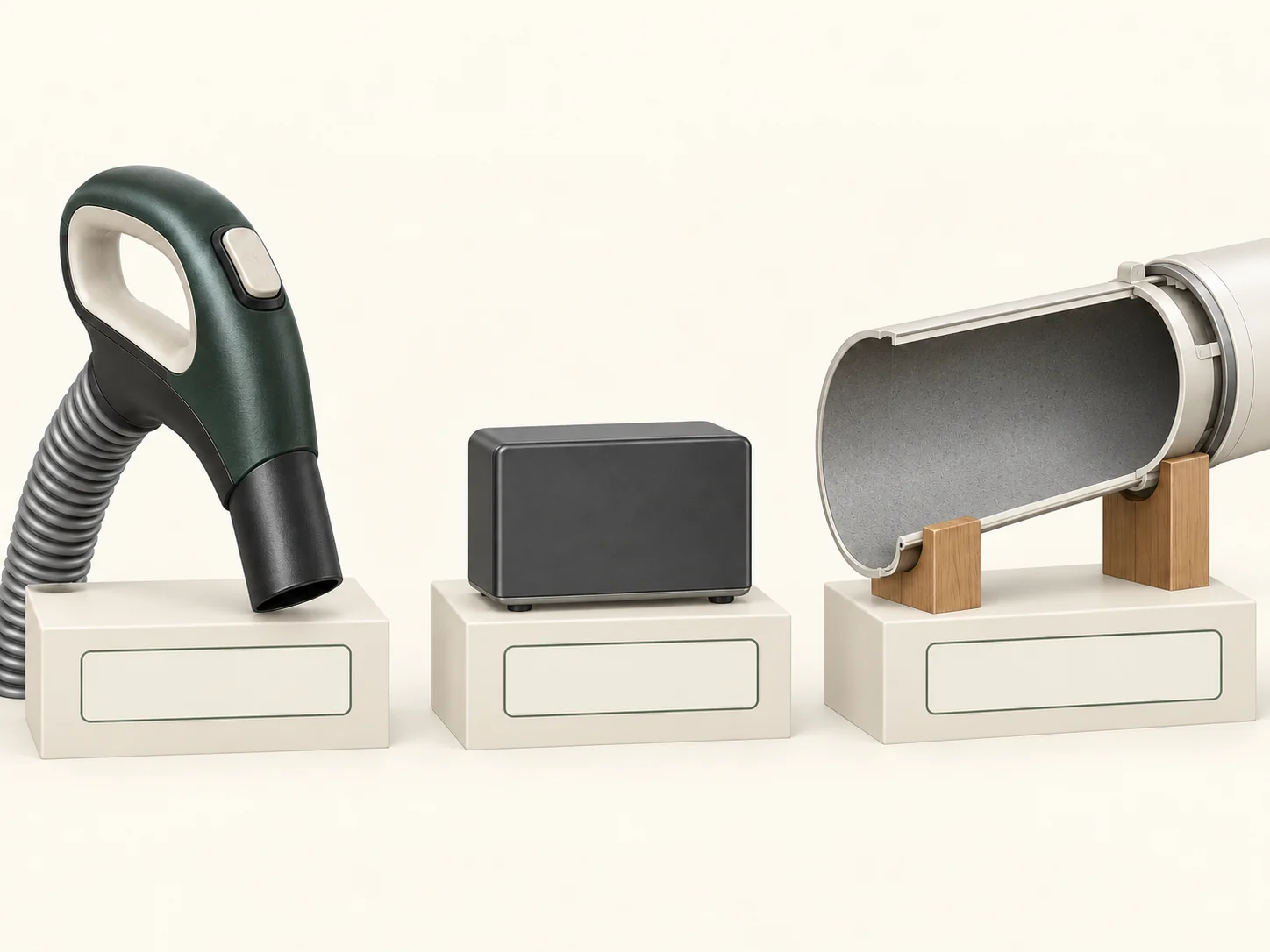
- Start/stop control
The control tells the unit to start or stop. The exact handle and inlet controls depend on the system.
- Control equipment
Some documented systems use a remote handle and receiver. This closed box is an illustration, not an identified receiver in your home.
- Air-and-dirt pipe
The pipe has a separate job: carrying air and picked-up dirt. Hearing the motor start does not tell you how well that route is working.
What does this illustration leave out?
The control box is a simplified example, not a particular receiver or wiring layout. The parts are disconnected, so the picture shows no working signal or airflow. Your manual identifies your system’s controls and compatible accessories. This picture compares the jobs of controls and pipes; it is not a wiring or troubleshooting procedure.
Did the unit fail to respond to its usual control, or did it run while cleaning became poorer?
Explore this with HomeAI ↗Opens an editable question. Nothing is sent until you choose to send it.Describe the change before choosing a repair
- The usual control gets no responseReport a starting problem and identify the control you normally use. This does not establish a pipe blockage.
- The unit starts but cleans poorlyReport the hose, tool, room and timing. The collection parts, air route and exhaust can still need assessment.
- The system has a wireless handleUse the exact handle, receiver and unit documentation. Similar-looking accessories are not automatically compatible.
Use this to explain the concern to service, not to perform wiring or compatibility tests.
Further reading: Cyclovac/Trovac · wireless handle supplement; Cyclovac · current linked household owner manual.
Where does the exhaust air go?
Exhaust is the air leaving the power unit after the collection stage. The exhaust outlet lets it leave; a muffler helps reduce exhaust noise. Cyclovac’s documentation treats exterior exhaust piping separately from the pipes bringing dirt into the unit. Your home’s final exhaust destination needs its own installation information. It cannot be identified from a port, a muffler or a nearby outdoor opening alone.
In the picture, the outlet and muffler are shown separately so their roles are easier to see. Their connections and final destination are not shown. For your home, ask: “Where does this unit discharge its air, and which sections of that route have you checked?” Keep the answer with the installation or service records, including any concealed section the provider could not assess.
The vacuum’s exhaust and motor-cooling air may have different routes, depending on the equipment. A central vacuum also has a different job from the system that ventilates rooms. Do not dismantle the muffler, clear a termination or close an opening as an experiment. Work affecting an exterior opening, electrical supply or shared property needs the appropriate specialist and local project review.
Where does the exhaust air go?
An equipment cabinet, round outlet and cylindrical muffler are shown separately beside a wall frame. The picture leaves out the connecting exhaust route.
Numbers identify the parts explained below.
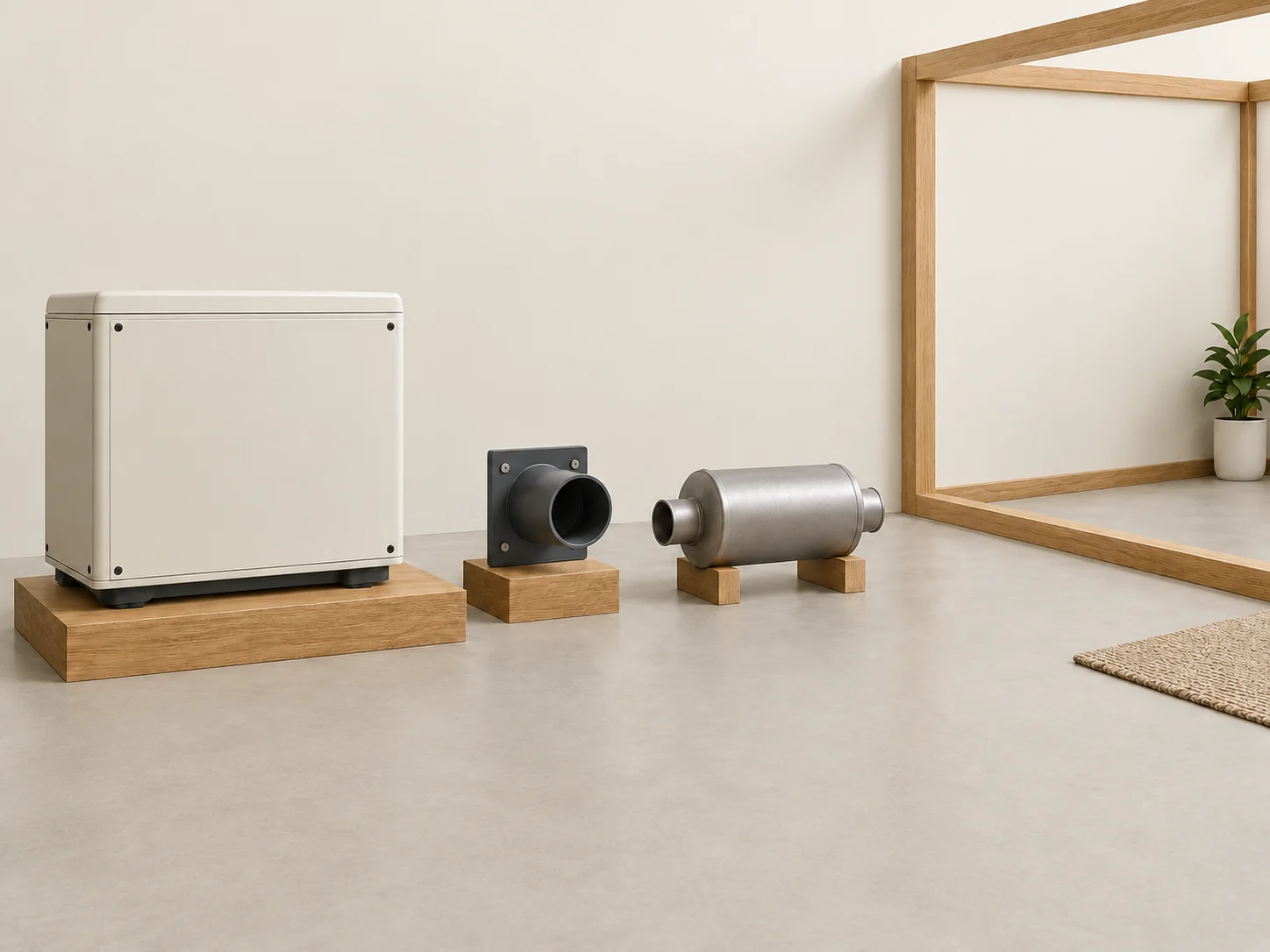
- Equipment cabinet
Exhaust air leaves the power unit after dirt collection. The cabinet is closed here, so the parts inside are not visible.
- Air outlet and muffler
The outlet lets air leave the unit. The muffler helps quiet that exhaust. They are shown separately so you can see both parts; the connecting pipe is not drawn.
- Where the air goes
The picture does not show the exhaust destination. Ask where your unit releases its air. A nearby outdoor opening may serve a different system.
What does this illustration leave out?
This illustration does not identify your unit or show its exhaust destination. The wall frame is not a pictured outside termination. The actual equipment and installation records explain where the air goes; a nearby outdoor opening may belong to another system. These parts are separated for illustration. The picture is not an exhaust installation plan.
Where does my vacuum release its exhaust air, and has that route been checked?
Explore this with HomeAI ↗Opens an editable question. Nothing is sent until you choose to send it.How do you know which maintenance instructions apply?
Start with the exact unit model and its manual. Bag, filter-only and hybrid systems have different care instructions, and different filters within one unit can have different jobs. Some have owner-care instructions; others are checked by the manufacturer’s service provider. A filter that looks like another filter may still need different handling. Identify the part before deciding what care it needs.
Ask the provider to resolve any mismatch between an older supplied manual and current information for your model. Keep the applicable instructions with the home’s records. When permitted care is completed, record the date, part or component, and who did the work. If the part, safe access or electrical isolation is unclear, arrange service instead of opening the unit to find out.
The manufacturer makes some care frequency dependent on use, so a generic internet calendar cannot settle every task. Ask: “What care applies to this configuration, what can I safely do using its instructions, and what needs a service visit?” Keep care and diagnosis separate. A bag replacement records one completed task; it does not automatically mean the hose, concealed pipes or exhaust were also assessed.
Does a maintenance reminder mean something is wrong?
Some reminders suggest care based on running time rather than measuring how full a bag is or how a filter is performing today. Cyclovac’s named DataSync system is an example: the manual describes its maintenance indications as timing-based suggestions. Cyclovac’s glossary says DataSync was discontinued in May 2022. It remains useful for understanding older equipment, but it is not a feature to assume on a new unit.
Read the meaning of your actual symbol in the correct instructions. Note when you noticed it, and keep completed care in a separate entry. A reminder, a completed task and a finding that explains poor cleaning are three different pieces of information. Ask: “What triggers this indication, and does it relate to the problem I reported?” An unfamiliar light needs identification rather than a guessed meaning.
The same care is useful when reading advertised performance. Airflow describes a quantity of air moved; a suction-related rating describes a different characteristic. Ask for the units and test conditions before comparing numbers. A product rating is not a measurement at your floor tool. A technician’s result should say where and how it was measured, and what documented comparison makes it useful for your concern.
What should you tell a service provider?
A useful request can be simple: “Cleaning became weaker in the upstairs bedroom during normal use with this hose and floor tool. The unit still responded to the usual switch. Here are the model information and earlier service invoice.” Describe what actually happened, including approximate dates when that is all you remember. Add any unusual noise, unexpected stop or visible external damage you already noticed from safe access.
Gather existing documents first: unit and accessory manuals, known installation or alteration dates, and previous service findings. Do not create new faults or collect dangerous proof. Avoid test debris, renovation dust, opening another inlet during operation, reaching moving parts or deliberately blocking an opening. A service provider can decide which unit, hose, tool, inlet, collection parts or built-in pipes need assessment.
These Canadian manufacturer examples explain their products; they do not replace requirements for your location or identify every brand. Choose a provider familiar with the equipment. Electrical concerns need an appropriately qualified electrician. In a shared building, involve the authorized manager before accessing or altering common services. Ask what the visit will cover, which complementary specialist may be needed, and what will remain outside the assessment.
What can a bag replacement tell you?
Fictional example: Maya notices poorer floor pickup during ordinary cleaning with the same hose and tool. The vacuum still responds to its usual control. She remembers seeing a maintenance reminder earlier, but not the exact date. A later service invoice records a bag replacement. It gives no findings about the hose, built-in pipes or exhaust. These are invented learning details, not an actual customer history.
Maya separates what she knows: the unit started, cleaning changed, a reminder appeared, and an invoice records a bag replacement. The invoice tells her what work was recorded, but it does not explain why pickup became poor. She sends that short timeline to the provider and asks which assessment will answer the cleaning question. She does not send objects through the inlets to search for a blockage.
Suppose the fictional technician later confirms a hose problem and records that the concealed pipes were not included in the visit. Both statements matter. The hose finding supports the proposed hose work; the hidden pipes remain unassessed. If later normal cleaning improves, Maya can record that follow-up with the same room, hose and tool. It is useful feedback, not a measured whole-system performance result or an air-quality guarantee.
Maya’s fictional records: what do they tell her?
- What she noticedPickup worsened with the same hose and tool during ordinary use. No airflow measurement was taken.
- What the invoice recordsA bag was replaced. The invoice says nothing about checking the hose, pipes or exhaust.
- What the later technician foundA hose problem was confirmed. Concealed pipes were outside that visit’s assessment, so they remain unchecked.
- What happened afterwardsImproved normal cleaning is useful feedback. It does not certify whole-system performance or indoor air quality.
Maya and all findings in this example are fictional.
Further reading: Cyclovac · current linked household owner manual; Cyclovac Canada · bag and filter maintenance context.
What should buyers and new homeowners ask for?
Ask the seller or builder to identify the installed unit, hoses, tools, inlets and normal controls, and provide the applicable manuals. Ask whether the system is complete, what functional check was actually performed and which locations or accessories it included. A demonstration or invoice is useful, but its meaning depends on that detail. Neither automatically verifies every pipe concealed inside the home.
For a service report, ask three things: what was checked, what was found, and what still needs attention. It should identify the components involved and the work recommended. If it includes measurements, keep the method, location, units and comparison used. A finding about one hose should remain a finding about that hose. A unit-only assessment should not become “the entire system passed.”
Sellers can keep dated original records and open questions together in the home-care file. Buyers can use that record to decide whether they need equipment service, confirmation of a particular pipe route, an accessory assessment or specialist advice for planned changes. Ask what supports a repair or replacement recommendation. A larger power unit is not automatically the answer when the cause of changed cleaning is still unknown.
Practice the distinction.
The bag was replaced, but what caused poor cleaning?
Fictional example: Maya notices weaker pickup. The unit still starts normally, an earlier reminder has an approximate date, and an invoice records only a bag replacement.
Reported observations
- The unit responds to the usual start/stop control.
- Weaker pickup was noticed during normal use with the same hose and tool.
- The invoice does not record checks of the hose, built-in pipes or exhaust.
Compare the explanations
Expand each possibility to see the evidence needed to distinguish it. Similar symptoms can have different mechanisms.
The cause of weaker pickup is still unknown
The hose, collection parts, built-in pipes or exhaust could be involved. The observations do not locate the cause.
A technician’s assessment explaining which part was checked and what they found.
Replacing the bag may not explain the problem
A timing-based reminder and recorded bag replacement do not by themselves explain the change in cleaning.
The correct meaning of the reminder, the dated work and findings about the reported problem.
A useful next question
Tell the technician what changed and when. Ask what they will check to find the cause, and which parts are outside the visit.
This invented example supplies no measured performance, actual defect or completed property inspection.
Know what the words mean.
- Air-and-dirt route
- The connected floor tool, hose, wall inlet and pipes that carry air and dry dirt to the collection unit.
- Dirt collection system
- The bag, filters and container a particular unit uses to separate and hold collected dirt.
- Start/stop controls
- The start/stop controls that tell the unit to run. They have a different job from the pipes carrying air and dirt.
- Exhaust air
- Exhaust air leaving the power unit. The installed exhaust connections determine where that air goes.
- Motor cooling
- How air cools the motor. Thru-flow and bypass motor examples use different cooling arrangements.
- Time-based maintenance reminder
- A care reminder based on running time or a schedule, rather than a direct check of the bag or filter’s current condition.
Questions to bring
to the conversation.
- Which unit, hose, tools, controls, bag and filters belong to this system?
- What changed during normal use: starting, continued running, cleaning or a light or symbol?
- Which pipe and exhaust routes are documented, and which concealed connections are still unknown?
- What care was completed, and did that visit actually investigate the cleaning concern?
- What will the provider check, record and recommend, and what will remain unassessed?
Separate a showing observation, an existing record and a new professional assessment. Unknown means a question remains; it does not automatically mean a defect.
Use the evidence planner ↗Go to the source.
Original HomeAI explanation informed by these public references. Sources support the underlying guidance; they have not reviewed or endorsed HomeAI. Diagrams are conceptual, and calculator outputs depend on your inputs.
Publication & source review
First published .
Sources reviewed .
- Cyclovac · current linked household owner manual
Where this reference applies
Jurisdiction: Canadian manufacturer; named North American household model families
Edition: Visible IMPMOD982–SE’25; currently linked October 5, 2026. HTTP Last-Modified June 25, 2026 is server metadata, not a publication date.
Source reviewed: 2026-10-05 · UTC
Reading scope: Complete English content across all 36 PDF pages read from retained full extraction. Actual figure pixels inspected on pages 5, 6, 23 and 25; other rendered figure pages are not claimed inspected. French/Spanish text retained but not independently evaluated.
Named component roles, separated ordinary controls and symptoms; no model identity, installation approval, universal intervals, wiring, dismantling, clearing, reset or repair procedure. DataSync families remain a documented legacy example, not a current-sale claim.
- Cyclovac/Trovac · wireless handle supplement
Where this reference applies
Jurisdiction: Canadian manufacturer; exact named wireless accessory
Edition: Visible TBORFINST2–MR’26; current listing links 2026-v2. HTTP Last-Modified July 22, 2026 is server metadata.
Source reviewed: 2026-10-05 · UTC
Reading scope: Complete English content of the 16-page multilingual PDF read; source figures not inspected as pixels. Other language text retained without separate evaluation.
Separate remote command and receiver roles and accessory-specific compatibility context. No pairing, wiring, battery work, range guarantee, restart recipe or assumption that this accessory is installed.
- Cyclovac Canada · installation and use explanations
Where this reference applies
Jurisdiction: Canadian manufacturer’s Canada English storefront
Edition: No substantive publisher date established; observed October 5, 2026.
Source reviewed: 2026-10-05 · UTC
Reading scope: Full substantive main-page body captured and read, including retractable-hose, exterior exhaust and dry-use sections; embedded video and linked manuals not counted as read from this body.
Inlet-to-unit piping and distinct retractable-storage or exhaust questions. No installation steps, clearances, numerical design, safe-air/microbe claim, easy-installation assurance or inferred exterior discharge.
- Cyclovac Canada · filtration configurations
Where this reference applies
Jurisdiction: Canadian manufacturer’s Canada English storefront
Edition: No substantive publisher date established; observed October 5, 2026.
Source reviewed: 2026-10-05 · UTC
Reading scope: Complete substantive main-page body captured and read. Page photographs were not separately inspected.
Bag, retained-filter and hybrid role distinctions only. Marketing health, allergy, zero-emission and perfect-capture claims withheld; no conversion procedure or current condition inference.
- Cyclovac Canada · bag and filter maintenance context
Where this reference applies
Jurisdiction: Canadian manufacturer’s Canada English storefront
Edition: No substantive publisher date established; observed October 5, 2026. Web family naming differs from the linked SE’25 manual in some exceptions.
Source reviewed: 2026-10-05 · UTC
Reading scope: Complete substantive main-page body captured and read; step photographs not separately inspected.
Model-dependent care, timing-reference limitations and different filter roles. No numeric interval, washing/removal/reset instructions, chemicals, universal family applicability or warranty entitlement.
- Cyclovac Canada · airflow, suction and DataSync terminology
Where this reference applies
Jurisdiction: Canadian manufacturer’s Canada English storefront
Edition: No overall publisher date established; body states DataSync discontinued May 2022. Observed October 5, 2026.
Source reviewed: 2026-10-05 · UTC
Reading scope: Complete substantive main-page body captured and read.
Airflow quantity and need to read rating terms separately; discontinuation bounds legacy illustrations. No water-lift-to-speed equation, airwatt formula, powerhead outcome, universal performance comparison or numerical model selection.
- Cana-Vac · motor airflow roles
Where this reference applies
Jurisdiction: Canadian manufacturer; Blainville, Québec address visible
Edition: No substantive publication/update date established; copyright year is not an article date. Observed October 5, 2026.
Source reviewed: 2026-10-05 · UTC
Reading scope: Full substantive page body captured and read; no separately inspected figure pixels.
Documented thru-flow versus bypass cooling roles. No motor identification from a cabinet, longevity ranking, performance guarantee, sales recommendation or internal service instructions.
- Cana-Vac · named motor component and exhaust roles
Where this reference applies
Jurisdiction: Canadian manufacturer; named thru-flow and bypass examples
Edition: No substantive publication/update date established; observed October 5, 2026.
Source reviewed: 2026-10-05 · UTC
Reading scope: Full substantive page body captured and read. Manufacturer figure text is available; the source figures themselves were not inspected.
Motors drive fans; cooling and collected-air discharge can be separate roles. No reproduced component geometry, fan-stage sizing, brand quality claim or claim that a pictured motor is installed.
Have a question about your home?
Start with the symptom, timing and what you have observed.
Ask HomeAI