Jump to a question in this guide
- Why are the assessment, bill and purchase price different?
- Which date and property description does the assessment use?
- Why can a sale disagree with the assessed value?
- How does an assessed value become a tax charge?
- Does the bill tell me what is still owing?
- Why can construction produce another bill?
- Who handles an assessment concern?
- How can the tax file improve the budget?
- What does a fictional renovated-home purchase reveal?
- What belongs in the final handover?
- Connect a dated assessment, the actual tax charge, account status and the next owner’s budget.
- Connect each dated record with its actual scope.
- Keep unresolved enquiries and local or design limits visible.

The separate house-and-record scenes organize three questions: a dated assessment, a tax calculation and a negotiated purchase. Each needs its own records; the models do not establish one identical actual house or its value.
About this illustration
No actual assessment, property identity, date, price, rate or legal boundary is shown. This is a conceptual teaching model, not an assessment of your home.
6 picture lessons appear beside the questions in this guide. Use them to understand the explanation, then consider what it means for your home.
Why are the assessment, bill and purchase price different?
An assessment estimates a property's value for a particular taxation system. A tax bill sets out the tax charged for its stated period. A purchase price is the amount the buyer and seller agree in their transaction. All three can concern the same home and still differ without one document being wrong. Start by asking what each number is doing.
The distinction matters when a listing says the home is below assessment or has low taxes. Neither phrase establishes the right purchase price or the next owner's future bill. The assessment has dates and property assumptions; the quoted tax amount has a year and coverage; the household has an intended use and budget. Connect those facts before making a comparison.
This guide uses Calgary municipal pages and Ontario MPAC education as named Canadian examples. Their assessment cycles, tax administration and review processes are not interchangeable. No national tax rate, reassessment schedule or appeal deadline is supplied. Read the actual municipality's current records and obtain appropriate advice for the property being bought or sold.
The existing comparable-sales guide compares transaction evidence, while the closing-cash guide follows money needed to complete a purchase. Here the question is how assessment, billing, account status and future tax budgeting fit together. A building inspection remains a separate technical task; a tax value cannot certify the roof, sewer or electrical installation.
Start a folder with the assessment notice, relevant bill, appropriately obtained account record and a description of present use and recent changes. Keep each date visible. Do not circulate owner access codes, banking details or unrelated personal information. A shareable index can identify the document and question without exposing the owner's complete private file.
One property enquiry, three different numbers
The separate house-and-record scenes organize three questions: a dated assessment, a tax calculation and a negotiated purchase. Each needs its own records; the models do not establish one identical actual house or its value.
Numbers identify the parts explained below.
- Assessment scene
Organizes the dated value enquiry. Read the actual notice and its assumptions.
- Calculation scene
Organizes the tax-charge enquiry. Use the authority’s applicable calculation and actual bill.
- Purchase scene
Organizes the transaction enquiry. Use current sales, terms and condition evidence.
- Separated models
Keep the purposes distinct. Their shapes are conceptual and are not a measured before-and-after record.
What does this illustration leave out?
No actual assessment, property identity, date, price, rate or legal boundary is shown. This illustration explains an idea. It is not an installation guide.
Which actual document, date and scope support this value, charge or account answer?
Explore this with HomeAI ↗Opens an editable question. Nothing is sent until you choose to send it.One property enquiry, three different numbers
The separate house-and-record scenes organize three questions: a dated assessment, a tax calculation and a negotiated purchase. Each needs its own records; the models do not establish one identical actual house or its value.
- Assessment scene
- Organizes the dated value enquiry. Read the actual notice and its assumptions.
- Calculation scene
- Organizes the tax-charge enquiry. Use the authority’s applicable calculation and actual bill.
- Purchase scene
- Organizes the transaction enquiry. Use current sales, terms and condition evidence.
- Separated models
- Keep the purposes distinct. Their shapes are conceptual and are not a measured before-and-after record.
What remains unknown: No actual assessment, property identity, date, price, rate or legal boundary is shown.
A useful question: Which actual document, date and scope support this value, charge or account answer?
Which date and property description does the assessment use?
A valuation date describes the market conditions used to estimate value. A condition date identifies the physical characteristics considered in the particular process. The date on which a notice arrives is another date again. Reading only the large dollar value removes information needed to understand what the estimate means and how it differs from today's purchase discussion.
Calgary's single-residential assessment page describes market value at July 1 of the preceding tax year and physical condition and characteristics at December 31. It also describes annual analysis rather than starting with the preceding assessment. These are Calgary examples read for this guide, not dates to copy onto a property elsewhere in Canada.
MPAC describes Ontario mass appraisal as valuing groups of properties at a common date using property information, common methods and sales analysis. Its sales explanation discusses adjusting transactions to the valuation date. Do not transplant Calgary's annual timetable into that Ontario explanation or assume a notice received after purchase values the property at the purchase date.
Compare the notice with the actual property description. An apparent difference in floor area, property type or recorded improvement needs clarification of definitions and coverage. A listing's area measurement may have a different method or scope. Ask the assessor or qualified measurement provider to explain the difference before declaring that either figure proves an error.
Keep factual correction separate from a desired market conclusion. A dated addition or incorrect characteristic creates a precise enquiry. Saying a buyer would pay less is a different argument needing relevant evidence and the proper process. The assessment office explains its records and process; the transaction representative helps frame current sales comparisons within their role.
Different dates answer different questions
The market reference, physical description and transaction date serve different purposes. The positions here show a conceptual sequence, not a Canadian timetable.
Numbers identify the parts explained below.
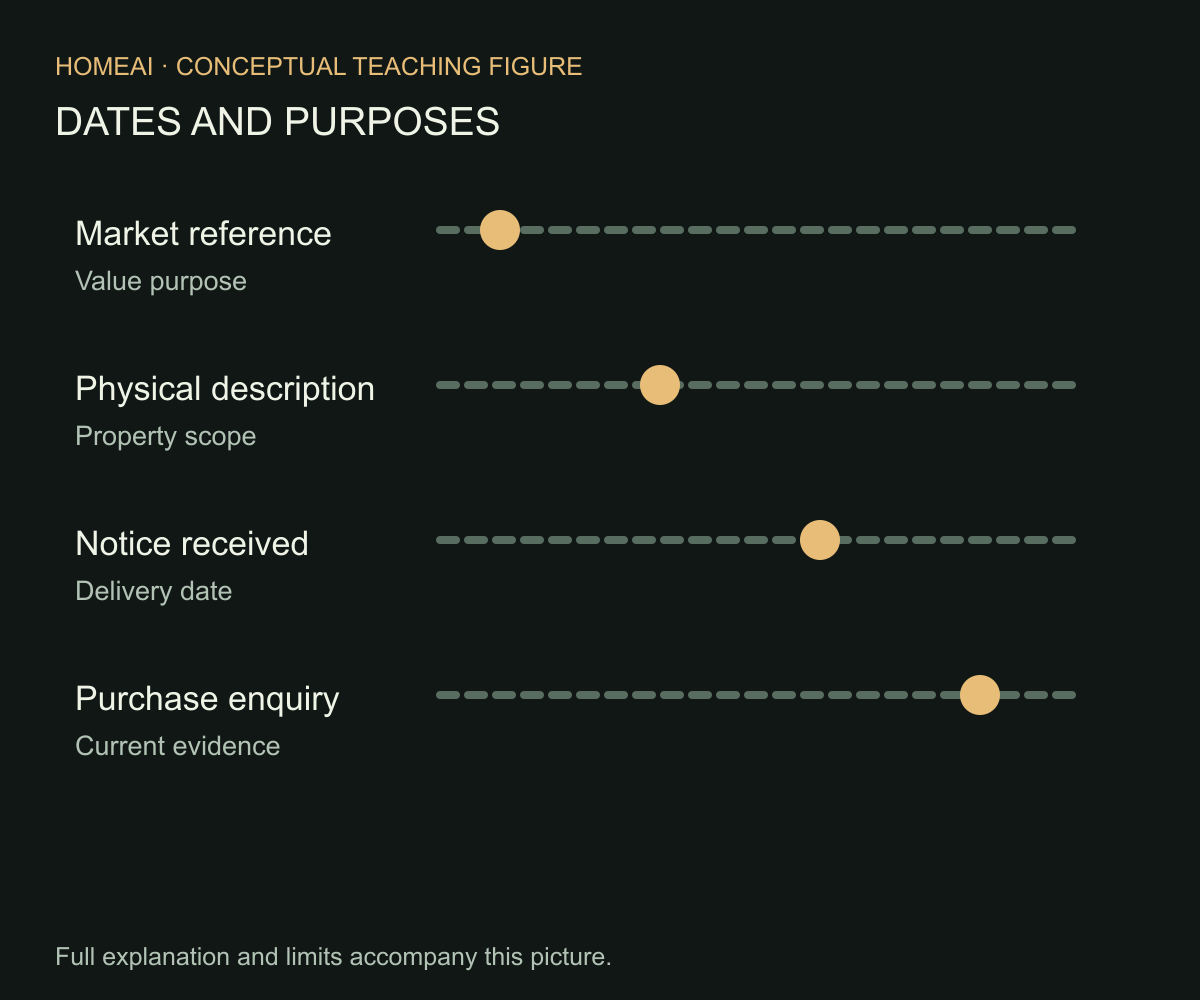
- Market reference
Defines the market conditions used. Read the actual authority’s valuation date.
- Physical description
Defines the characteristics considered. A separate condition date exists in the named Calgary example.
- Notice received
Tells when the notice arrived. It does not silently replace the reference date.
- Purchase discussion
Concerns current terms and evidence. Compare the actual property and relevant sales.
What does this illustration leave out?
No universal ordering, interval, reassessment cycle or legal deadline is supplied. This illustration explains an idea. It is not an installation guide.
Which actual document, date and scope support this value, charge or account answer?
Explore this with HomeAI ↗Opens an editable question. Nothing is sent until you choose to send it.Different dates answer different questions
The market reference, physical description and transaction date serve different purposes. The positions here show a conceptual sequence, not a Canadian timetable.
- Market reference
- Defines the market conditions used. Read the actual authority’s valuation date.
- Physical description
- Defines the characteristics considered. A separate condition date exists in the named Calgary example.
- Notice received
- Tells when the notice arrived. It does not silently replace the reference date.
- Purchase discussion
- Concerns current terms and evidence. Compare the actual property and relevant sales.
What remains unknown: No universal ordering, interval, reassessment cycle or legal deadline is supplied.
A useful question: Which actual document, date and scope support this value, charge or account answer?
Why can a sale disagree with the assessed value?
A transaction occurs between particular parties at a particular time with particular terms. An assessment applies a valuation method across properties for its stated purpose and date. Calgary distinguishes a single sale from its mass-appraisal estimate. A price above assessment therefore does not establish overpayment, just as a lower price does not establish a bargain.
Ask whether the comparison concerns the same interest and physical property. A sale including different land, substantial furnishings or another negotiated component needs its terms understood. MPAC's Ontario sales explanation discusses non-open-market transactions and adjustments. This guide does not determine which transaction qualifies or calculate a tax value from a sale; it teaches why context matters.
Market conditions may differ between the assessment's reference date and the purchase discussion. Relevant comparable sales need their own timing and property comparison. Avoid applying a general neighbourhood percentage as though it were an appraisal of this home. Condition, location, configuration and transaction terms can matter differently in the actual evidence.
A renovated kitchen may look persuasive while the assessment and inspection answer different questions. The assessor's description does not prove concealed work was permitted or properly completed. Keep renovation approvals, drawings, equipment records and specialist findings connected to the purchase decision rather than expecting the tax system to have investigated them all.
For a seller, describe the assessment accurately with its year and context. For a buyer, ask what supports the proposed price beyond the assessment comparison. Professional valuation, market analysis and technical assessment have different scopes. Have each provider explain the question answered and information used instead of treating the highest-looking number as authoritative for every purpose.
How does an assessed value become a tax charge?
The assessment supplies a value and relevant classification. The authority applies its applicable tax calculation for the year. Calgary's single-residential page describes multiplying yearly assessment by the approved municipal rate, while its calculator separately displays City and Province components. The actual bill can contain account-specific factors, so a calculator result remains an estimate.
The value and rate work together. If every assessed value changes, that does not by itself tell a household how the authority's required tax revenue, applicable rates or its share will change. Read the authority's current calculation explanation. Do not assume a percentage movement in assessment must create the same percentage movement in the bill.
A bare percentage is easy to misuse across jurisdictions. One authority may express its rate differently or show different components; a quoted amount may cover a different year or classification. Compare matching units and scope. A rate per thousand dollars of assessed value is not the same numerical input as a decimal multiplier.
This guide supplies no current rate to reuse as a household estimate. Use the actual notice and current official calculator where available, preserving the entered year, classification and value. Label the output estimated and replace it with the actual bill when available. Do not substitute purchase price into an assessed-value field unless the authority expressly directs that treatment.
Separate tax charges from other ownership expenses. Utilities, condominium contributions, insurance and service contracts can be billed elsewhere. Ask what the quoted tax amount includes rather than assuming it covers all local services. A lower bill cannot alone establish lower total ownership cost or compensate for a consequential building repair.
The assessment is an input, not the whole bill
The assessed value and applicable tax calculation produce a charge; later transactions affect the account. Keep the bill and current balance as separate outputs.
Numbers identify the parts explained below.
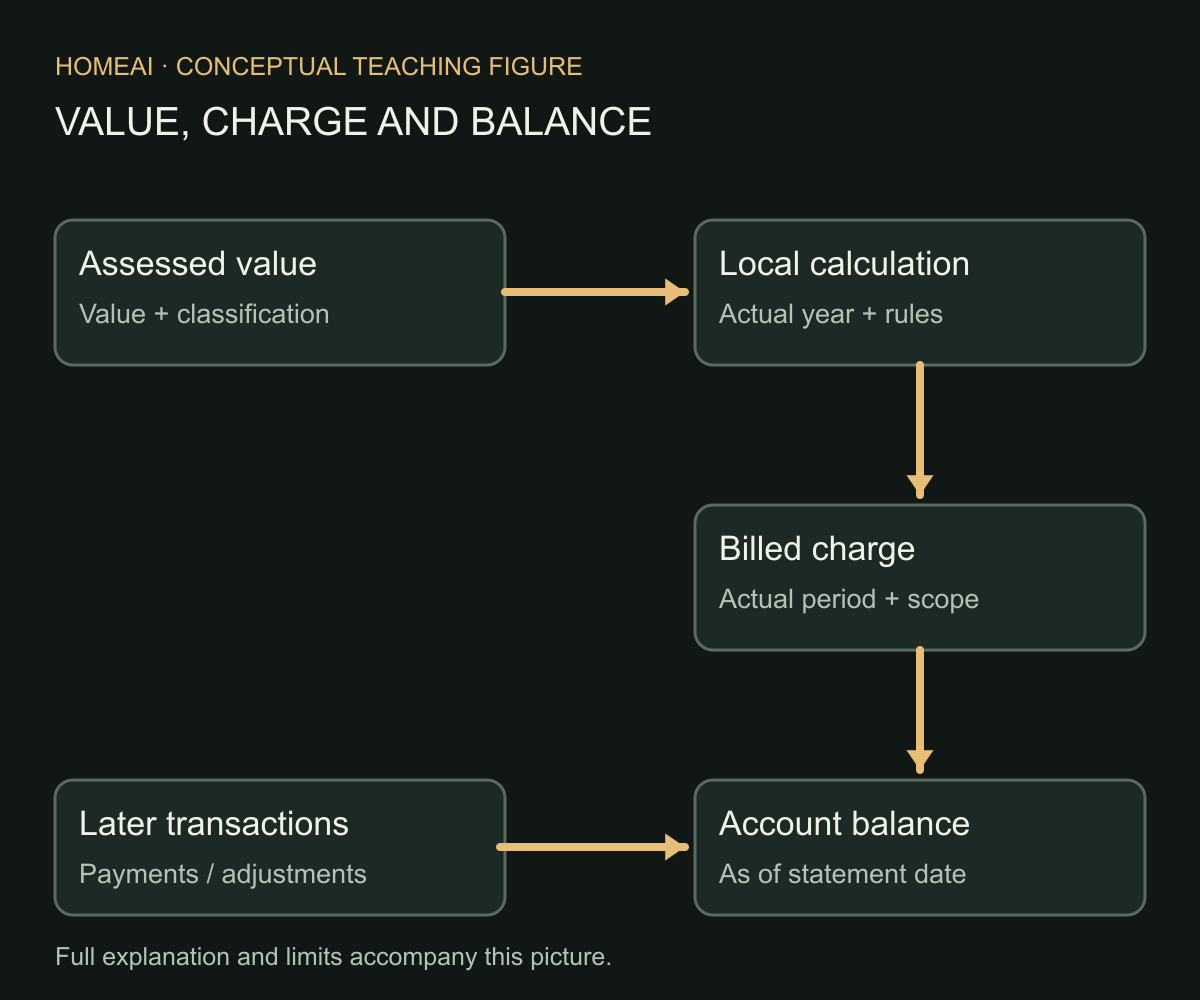
- Assessment input
Supplies value and classification. Its own reference dates remain relevant.
- Applicable calculation
Uses the authority’s current rules and rates. No numerical rate or national formula is supplied.
- Billed charge
Records the tax charged for the period. Actual account-specific factors may matter.
- Account transactions
Record later payments or adjustments. Use a current official account record.
What does this illustration leave out?
No actual rate, tax calculation, payment result or future bill is established. This illustration explains an idea. It is not an installation guide.
Which actual document, date and scope support this value, charge or account answer?
Explore this with HomeAI ↗Opens an editable question. Nothing is sent until you choose to send it.The assessment is an input, not the whole bill
The assessed value and applicable tax calculation produce a charge; later transactions affect the account. Keep the bill and current balance as separate outputs.
- Assessment input
- Supplies value and classification. Its own reference dates remain relevant.
- Applicable calculation
- Uses the authority’s current rules and rates. No numerical rate or national formula is supplied.
- Billed charge
- Records the tax charged for the period. Actual account-specific factors may matter.
- Account transactions
- Record later payments or adjustments. Use a current official account record.
What remains unknown: No actual rate, tax calculation, payment result or future bill is established.
A useful question: Which actual document, date and scope support this value, charge or account answer?
Does the bill tell me what is still owing?
A bill records a charge. An account statement records transactions and balance as of its stated point in time. The documents therefore give different answers. A copy of an original annual bill may not show later payments, adjustments or penalties. Seeing the annual charge is not the same as confirming the account has been settled.
Calgary's document-request page describes recent bill copies as showing original details without payment or penalty updates. Its comparison places current balance and transaction history in a tax statement. The City identifies different routes for owners and commercial non-owner enquiries. Use the authorized process rather than asking a seller to share a private portal password.
Ask the legal professional which current tax information is needed for the purchase, how it will be obtained and how completion adjustments are handled. A marketing screenshot may be useful background but can become stale. The professional needs to identify the property, coverage date and actual account information relevant to the transaction.
A mortgage payment may include money collected toward taxes. That funding arrangement needs explanation from the lender; it is not direct evidence of the municipality's balance. A scheduled instalment or bank transfer instruction also differs from a recorded payment. Ask which confirmation establishes receipt without exposing bank details broadly.
Keep account confirmation separate from title, legal completion and building condition. A statement answers its own account question within its scope. It does not certify all charges, future liabilities, land rights or technical compliance. The legal reviewer should explain what the actual documents cover and which other enquiries remain necessary.
A notice, a bill and an account record have different jobs
Separated document trays help keep the questions apart: what was assessed, what was charged and what the current account records. The pictured paper and calculator contain no usable account information.
Numbers identify the parts explained below.
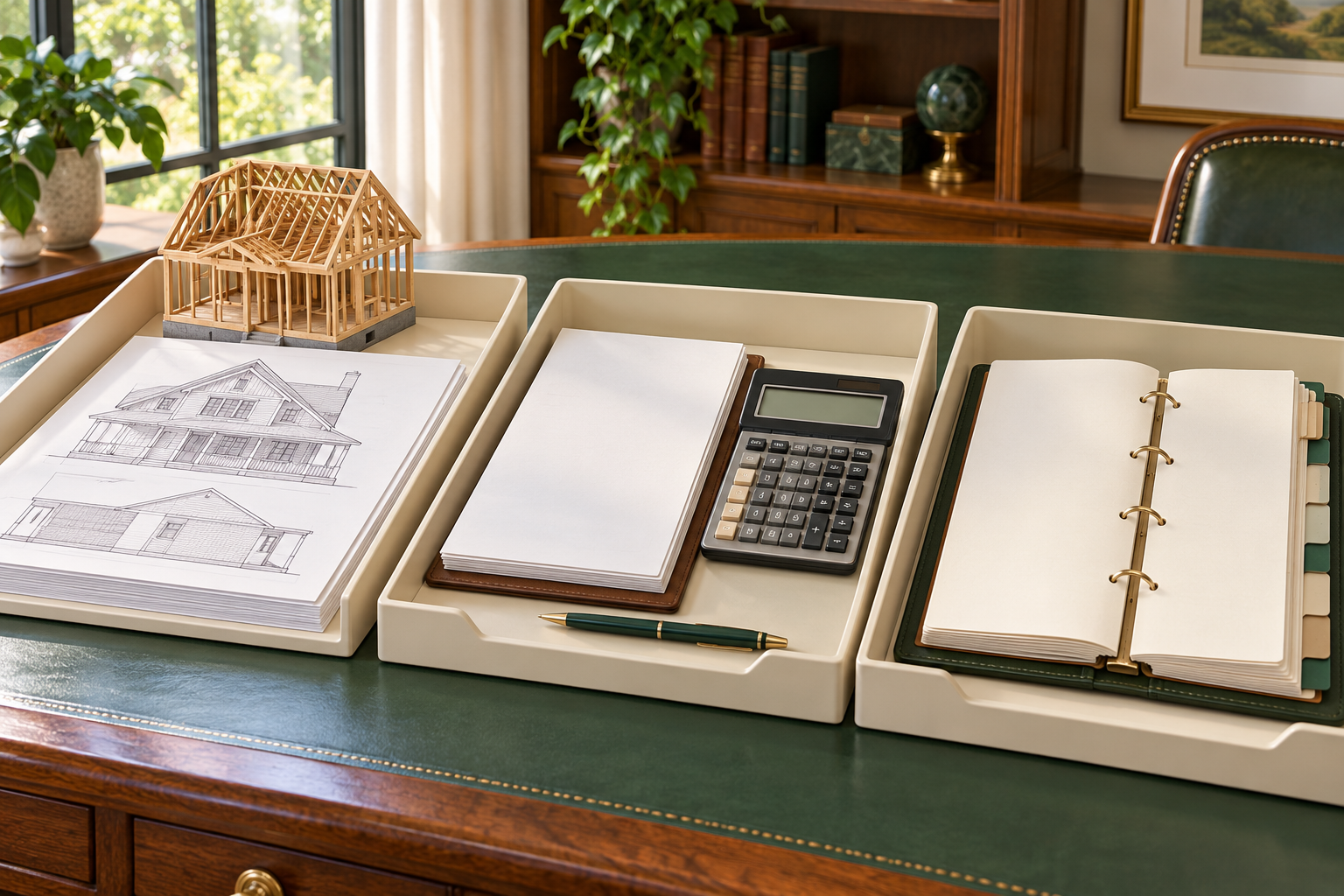
- Notice tray
Prompts the assessment-value question. Actual reference dates belong to the real notice.
- Bill tray
Prompts the annual-charge question. The charge alone does not establish later payments.
- Account tray
Prompts the balance and transaction question. Use an appropriately obtained current statement.
- Desk calculator
Represents calculation support. Its generated marks are not read as numbers or a tax result.
What does this illustration leave out?
No document is genuine and no payment, account balance, receipt or tax result is established. This illustration explains an idea. It is not an installation guide.
Which actual document, date and scope support this value, charge or account answer?
Explore this with HomeAI ↗Opens an editable question. Nothing is sent until you choose to send it.A notice, a bill and an account record have different jobs
Separated document trays help keep the questions apart: what was assessed, what was charged and what the current account records. The pictured paper and calculator contain no usable account information.
- Notice tray
- Prompts the assessment-value question. Actual reference dates belong to the real notice.
- Bill tray
- Prompts the annual-charge question. The charge alone does not establish later payments.
- Account tray
- Prompts the balance and transaction question. Use an appropriately obtained current statement.
- Desk calculator
- Represents calculation support. Its generated marks are not read as numbers or a tax result.
What remains unknown: No document is genuine and no payment, account balance, receipt or tax result is established.
A useful question: Which actual document, date and scope support this value, charge or account answer?
Why can construction produce another bill?
An advertised tax amount can describe a property before a recent building or improvement was included. The buyer needs the physical scope behind the amount, not merely a recent-looking year. A land-only history and a completed home support different budget questions even when the address and owner have remained unchanged.
Calgary's supplementary-bills page describes supplementary assessment and a separate bill for construction or improvements completed or occupied during the tax year that were not included on the annual roll. It explains a months-based calculation in that city's process. This guide does not apply the formula, select a date or predict an actual charge.
Ask the appropriate office whether another assessment or bill exists or remains to be determined, and have the legal professional explain transaction treatment. Keep reported construction completion, occupancy and actual assessment information distinct. Builder handover, permit status and tax billing are related enquiries, but none silently establishes the others.
The same discipline helps when a seller has added space or changed use. Explain the work and dates accurately through the transaction process. Obtain the assessment office's answer rather than assuming a permit means the tax account is fully updated. Conversely, a tax change does not establish that the alteration received every required approval.
Retain uncertainty in the budget until supported information replaces it. A placeholder can say the current bill does not establish taxation of the completed home. It should not become a fabricated estimate dressed as an official amount. Ask the lender and relevant household adviser how that uncertainty affects affordability and the intended purchase.
Match the building scope behind the quoted amount
A completed addition and the assessment or bill may have different coverage dates. Ask what is included and whether another official assessment or bill exists.
Numbers identify the parts explained below.
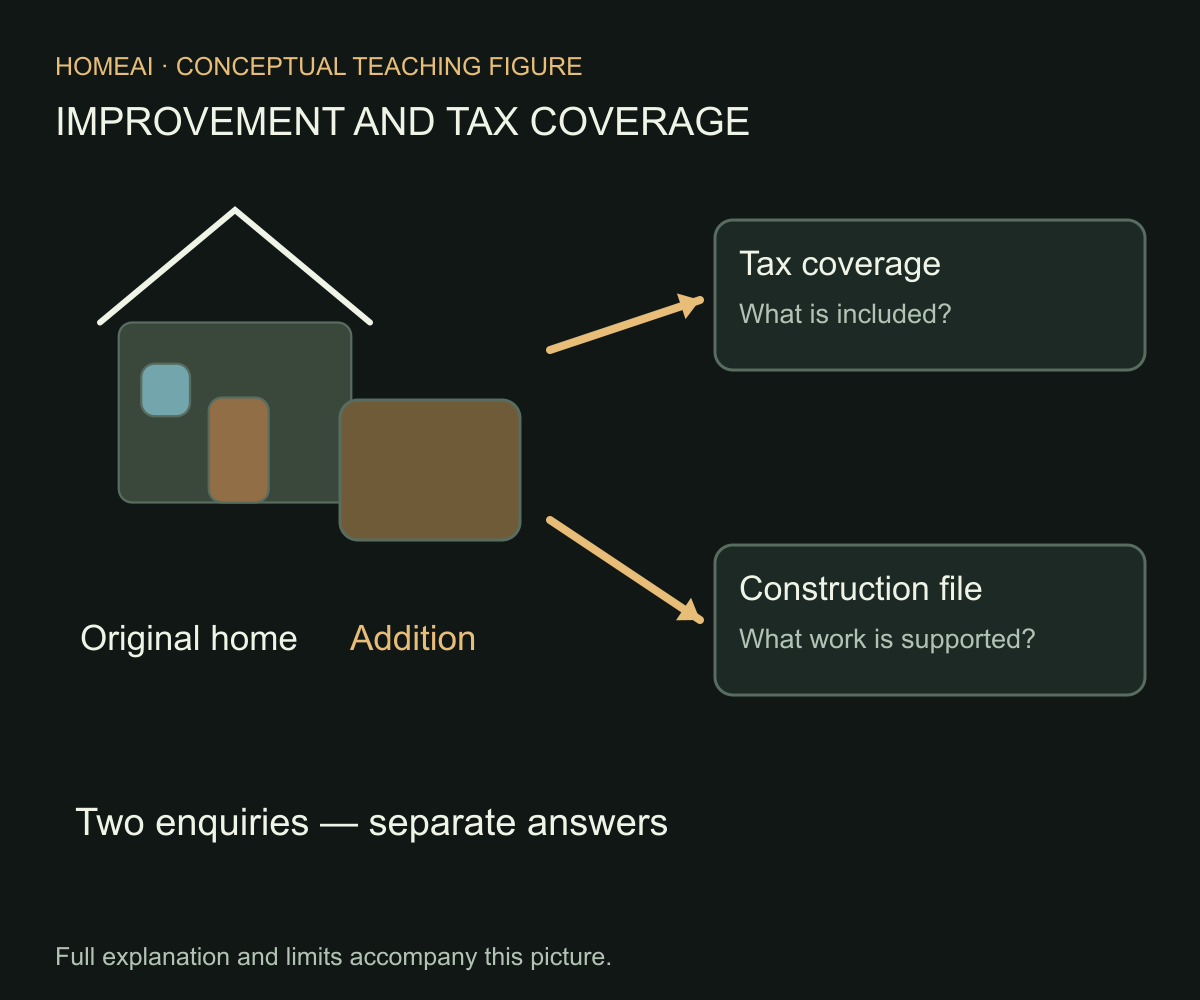
- Original property
Has its own dated assessment history. Identify what the original amount described.
- Later improvement
Changes the physical enquiry. Construction and occupancy records need actual dates.
- Authority confirmation
Establishes the tax-record scope. Ask about additional assessment or billing.
- Construction evidence
Answers a different question. Tax inclusion does not establish approval or workmanship.
What does this illustration leave out?
No supplementary amount, construction finding, occupancy status or approval is invented. This illustration explains an idea. It is not an installation guide.
Which actual document, date and scope support this value, charge or account answer?
Explore this with HomeAI ↗Opens an editable question. Nothing is sent until you choose to send it.Match the building scope behind the quoted amount
A completed addition and the assessment or bill may have different coverage dates. Ask what is included and whether another official assessment or bill exists.
- Original property
- Has its own dated assessment history. Identify what the original amount described.
- Later improvement
- Changes the physical enquiry. Construction and occupancy records need actual dates.
- Authority confirmation
- Establishes the tax-record scope. Ask about additional assessment or billing.
- Construction evidence
- Answers a different question. Tax inclusion does not establish approval or workmanship.
What remains unknown: No supplementary amount, construction finding, occupancy status or approval is invented.
A useful question: Which actual document, date and scope support this value, charge or account answer?
Who handles an assessment concern?
An assessment concern starts with the notice, property facts and authority's current process. Calgary's review page asks owners to check details, compare relevant information and contact the City. It distinguishes discussion from a formal complaint to the independent review board. These are separate steps, not a universal Canadian appeal procedure or a promise of a reduced value.
Check the notice for applicable dates and ask the authority or qualified adviser what action is available to the relevant person. This guide gives no deadline or assurance that a new buyer can revive an expired opportunity. Do not assume a sale restarts a review period or transfers a pending matter in a particular way.
If a seller reports a challenge, obtain its appropriately shareable status record and have the legal professional explain its relevance. An enquiry submitted, a hearing scheduled and a final outcome are different events. Preserve unresolved status rather than budgeting as though a requested reduction had already been granted.
A factual question may need a measurement, drawing or construction record. A valuation question may need relevant sales evidence. A question about rights and completion treatment needs legal advice. Match the provider to the task; an inspector's observation about an addition cannot determine the review board's decision.
Record who will obtain the next answer and which budget or term depends on it. Some uncertainty may be acceptable with advice; other uncertainty may require reconsidering the plan. Do not invent a probability of winning a review. Keep submission, request, response and outcome clearly labelled as different statuses in the purchase file.
How can the tax file improve the budget?
Build a dated budget using the actual annual charge and its scope, then separately list account balances, completion adjustments and future expense questions. Tax expense for a period and cash required on completion day are different views. Do not count the same amount twice because it appears in both the budget and lawyer's statement.
Identify temporary assumptions. A future rate, changed assessment, newly completed improvement and unresolved classification affect confidence differently. Record what is known and which official answer would change the estimate. A news headline about a municipal budget cannot supply the exact next bill for this particular property.
Compare properties on a consistent basis. Confirm year, classification, physical scope and separately billed services before comparing advertised amounts. A neighbour's bill can have different facts. A monthly payment-plan amount can also be an instalment arrangement rather than a clean statement of the full annual expense.
Connect recurring expenses with building evidence. A household may need an official tax answer and a specialist quotation for a roof concern. The tax record does not price that work. Keep repair scope, timing and uncertainty visible rather than treating a low annual bill as a reason to ignore a technical finding.
Sellers can supply identified records and factual history; buyers can explain intended use and ask advisers to reconcile amounts. Preserve the version used for a decision. When newer information changes an estimate, record the reason and date. No calculator, representative or guide can guarantee a future tax bill for the household.
What does a fictional renovated-home purchase reveal?
Fictional buyers Mina and Joel consider an invented Calgary home with a recent addition. Its marketing sheet shows an assessment and annual tax amount; the asking price is different. No actual property, account or finding is represented. They label the year and purpose of each figure rather than choosing one as the correct home value.
They request the notice and bill through their representative. The bill predates information about the addition. That does not establish wrongdoing or a missing charge. It creates a question for the assessment office about which improvements the information includes and whether another assessment or bill exists. The example supplies no answer on behalf of that office.
Their legal professional separately obtains appropriate account information and explains proposed completion adjustments. The buyers do not infer payment status from the annual bill or lender's planned collections. No arrears, credit or supplementary amount is invented, and a requested enquiry is not described as a completed result.
The addition has its own construction file. Permit and completion questions remain with appropriate technical and legal scopes. Even an assessment description including the added space would not settle how it was built or what an inspection reached. Offer-price discussion uses sales and condition evidence rather than a fixed premium against assessment.
The case ends with a dated budget and named enquiries. Mina and Joel understand what the assessment estimates, what the bill charges and what a current account record must establish. They can explain which future expense remains uncertain. The guide promises no reduction, particular future bill, successful review or completed purchase.
Mina and Joel keep two enquiries open
The fictional couple checks the tax coverage of an addition while separately reviewing its construction records. One completed enquiry cannot silently close the other.
Numbers identify the parts explained below.
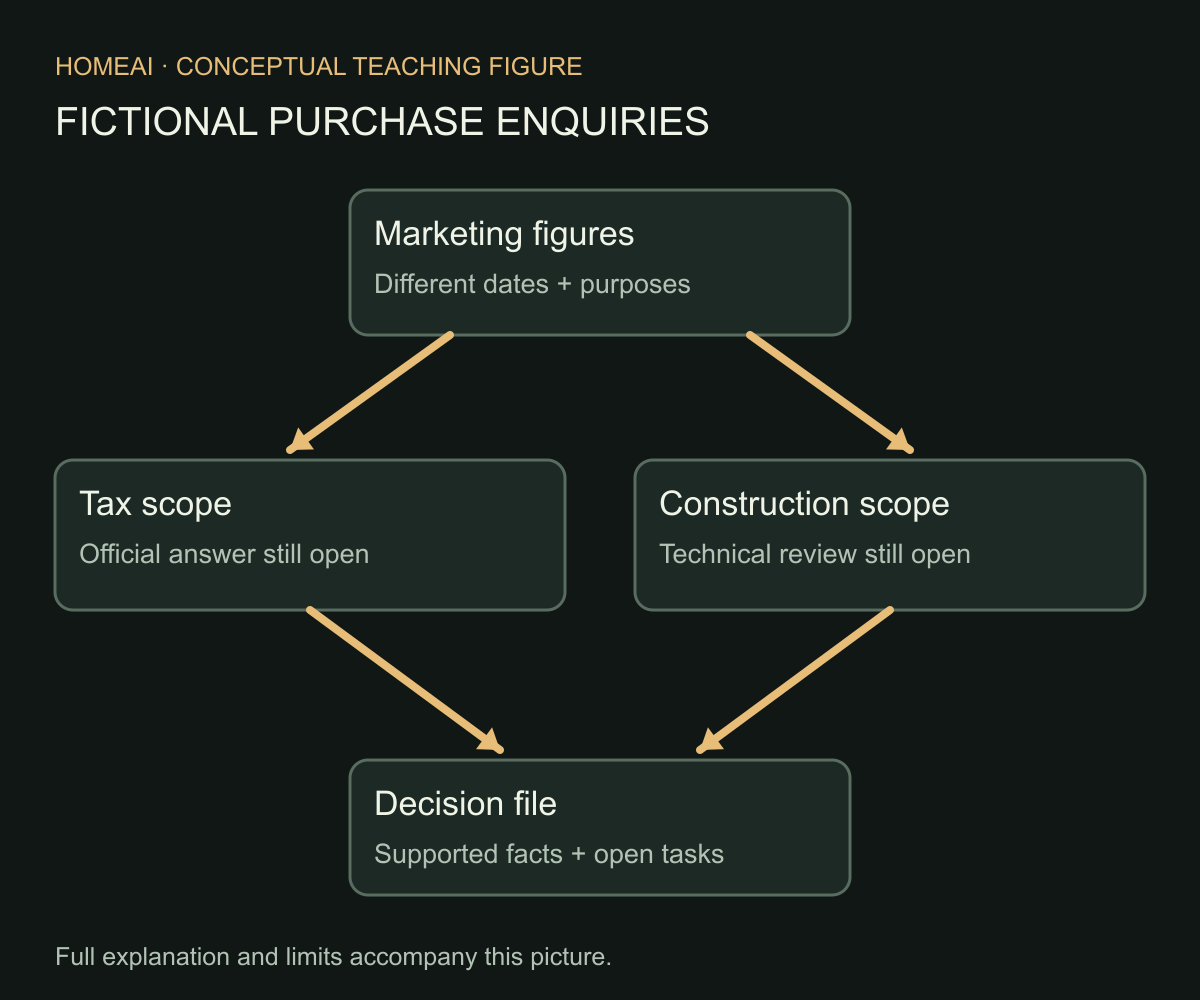
- Marketing figures
Different amounts and dates. No amount is invented in the fictional case.
- Tax enquiry
Which improvements does the file include?. Actual office answer remains open.
- Construction enquiry
What was approved and assessed?. Technical and legal scopes stay separate.
- Household decision
Uses supported records and open questions. No promised bill, reduction or purchase outcome.
What does this illustration leave out?
Fictional scenario only; no actual account or transaction outcome. This illustration explains an idea. It is not an installation guide.
Which actual document, date and scope support this value, charge or account answer?
Explore this with HomeAI ↗Opens an editable question. Nothing is sent until you choose to send it.Mina and Joel keep two enquiries open
The fictional couple checks the tax coverage of an addition while separately reviewing its construction records. One completed enquiry cannot silently close the other.
- Marketing figures
- Different amounts and dates. No amount is invented in the fictional case.
- Tax enquiry
- Which improvements does the file include? Actual office answer remains open.
- Construction enquiry
- What was approved and assessed? Technical and legal scopes stay separate.
- Household decision
- Uses supported records and open questions. No promised bill, reduction or purchase outcome.
What remains unknown: Fictional scenario only; no actual account or transaction outcome.
A useful question: Which actual document, date and scope support this value, charge or account answer?
What belongs in the final handover?
Preserve the relevant notice, bill, account confirmation and legal explanation of completion treatment securely. Add document dates, property identification and version references. Keep access codes out of a general home-care folder. A future reader should understand why each document was retained and which question it answers without receiving unnecessary private information.
Keep construction and use changes traceable alongside their approvals and work records. Identify whether tax information was confirmed before or after those changes. Do not rewrite an older record to appear current. A dated note can explain that later information exists and direct the reader to it while retaining the original.
For an unresolved assessment or billing matter, preserve actual status and the responsible contact route. A promised follow-up is not a decision. Check the current official process when action is needed, especially after ownership changes or a new notice. This guide establishes no representation rights, deadlines or legal outcome.
The municipal and MPAC pages were read October 19, 2026 in America/Edmonton; captures are recorded October 20 UTC. Calgary supplies municipal examples and MPAC Ontario context. Their processes can change. Rates, nationwide reassessment rules, future budgets and property-specific legal conclusions are deliberately not supplied.
The final explanation is simple: this value has this assessment purpose and date; this bill covers this charge and period; this account record describes this balance; this purchase decision uses current price and condition evidence. Keeping those statements connected and distinct makes the tax file useful rather than a collection of mismatched numbers.
Keep learning about the connected parts
- Comparable sales alongside property condition: ask what the difference means
- Cash required for closing: deposit, advance, adjustments and deadlines
- Your first year in a home: turn findings and bills into a budget
Canadian context and authorities · Visual atlas · Learning labs
Practice the distinction.
What does a fictional renovated-home purchase reveal?
Fictional buyers Mina and Joel consider an invented Calgary home with a recent addition. Its marketing sheet shows an assessment and annual tax amount; the asking price is different. No actual property, account or finding is represented. They label the year and purpose of each figure rather than choosing one as the correct home value.
Reported observations
- They request the notice and bill through their representative. The bill predates information about the addition. That does not establish wrongdoing or a missing charge. It creates a question for the assessment office about which improvements the information includes and whether another assessment or bill exists. The example supplies no answer on behalf of that office.
- Their legal professional separately obtains appropriate account information and explains proposed completion adjustments. The buyers do not infer payment status from the annual bill or lender's planned collections. No arrears, credit or supplementary amount is invented, and a requested enquiry is not described as a completed result.
Compare the explanations
Expand each possibility to see the evidence needed to distinguish it. Similar symptoms can have different mechanisms.
The quoted bill may describe an earlier physical scope
The fictional bill predates information about the addition. That timing creates an enquiry; it does not establish an omitted charge or an error.
The actual assessment and bill coverage, construction dates and the assessment office’s answer about included improvements or additional billing.
The current account may differ from the original annual charge
An annual bill and a lender’s planned collections do not establish later payments, adjustments or the municipality’s current balance.
Appropriately obtained current account information and the legal professional’s explanation of the proposed completion adjustments.
A useful next question
Ask the assessment office which improvements the tax information includes, and ask the legal professional which current account record and completion treatment support the purchase budget.
Fictional Calgary purchase only. No actual tax amount, arrears, credit, supplementary bill, legal result, review decision or completed purchase is represented.
Know what the words mean.
- Taxation assessment
- An estimate of property value for the applicable taxation system and reference dates.
- Valuation date
- The market reference date used by the particular assessment system.
- Condition date
- The date defining physical characteristics used by the relevant assessment.
- Mass appraisal
- Valuation of groups of properties at a common date with property data and shared methods.
- Tax charge
- The amount charged for the period identified on the actual bill.
- Tax account balance
- An account position as of its statement date, distinct from the original charge.
- Supplementary assessment
- An additional assessment within the relevant authority’s process; actual scope needs confirmation.
- Completion adjustment
- A transaction allocation explained by the legal professional from the agreement and records.
Questions to bring
to the conversation.
- Which dates and improvements does the assessment describe?
- Does the annual bill show a charge or a current paid account?
- What official information supports the future budget?
Separate a showing observation, an existing record and a new professional assessment. Unknown means a question remains; it does not automatically mean a defect.
Use the evidence planner ↗Go to the source.
Original HomeAI explanation informed by these public references. Sources support the underlying guidance; they have not reviewed or endorsed HomeAI. Diagrams are conceptual, and calculator outputs depend on your inputs.
Sources read October 19, 2026. Calgary municipal examples and Ontario MPAC assessment context have different local scopes. No national timetable, tax rate, review deadline or future bill is supplied. Case is fictional and images conceptual.
Publication & source review
First published .
Sources reviewed .
Have a question about your home?
Start with the symptom, timing and what you have observed.
Ask HomeAI